
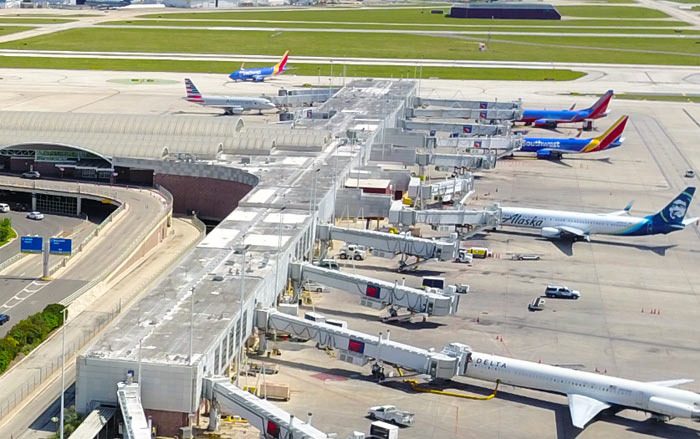
San Antonio International Airport is like a gateway to southern Texas for the people of San Antonio and the surrounding areas.
In terms of size, it may be smaller compared to Dallas or Houston, but it operates in a charming and practical manner that fits the city's atmosphere. In fact, the airport site is not small at all, covering 2,600 acres, which is slightly smaller than the 3,500 acres of the major city airport, LAX.
San Antonio International Airport has a unique Texas vibe, and from the moment you enter the arrivals area, you feel, "This is San Antonio." As a city where military bases and the tourism industry have developed together, the airport showcases a unique scene where travelers and soldiers naturally mix.
This airport is located about 10 kilometers north of downtown. Its proximity to the city makes it easily accessible, and you can reach the River Walk or the Alamo in just 15 minutes by car. Currently, the terminal is divided into two: A and B. Although small, it is efficiently laid out, so you rarely get lost.
Terminal A mainly serves domestic flights like Southwest Airlines, while Terminal B is used by major airlines such as United and American Airlines. International flights primarily head to Mexico and Central America, with routes to Cabo San Lucas and Mexico City being popular.
San Antonio Airport began as a military airfield during World War II in the 1940s. It was called 'Alamo Field' at the time and was used as a training base, later transitioning to a civilian airport and adopting its current name. The legacy of being a military city still exists, as military transport planes and training aircraft can often be seen flying in the skies near the airport. The coexistence of civilian and military operations at the airport well illustrates San Antonio's unique background.
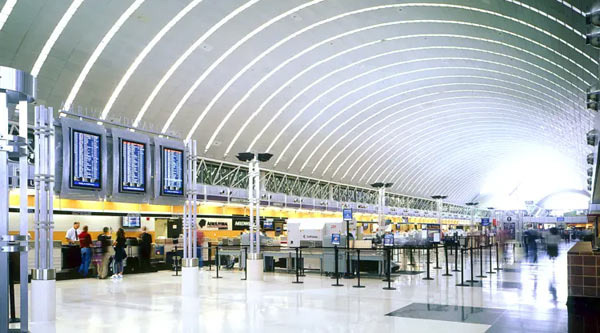
The interior of the airport is not large but is clean and has a strong local flavor. The entrance lobby features works by local artists, and the walls are adorned with a photo wall that captures the history and culture of San Antonio. Hanging from the ceiling of Terminal B is a biplane model that was used as a training aircraft during World War I, symbolizing that this area was the home of U.S. Air Force training.
Another charm of San Antonio Airport is its comfort. Unlike large hub airports, it does not feel crowded, and the time from security check to boarding is short, with plenty of relaxation areas throughout the airport. Restaurants and cafes also reflect local characteristics, featuring Tex-Mex eateries, barbecue joints, and local coffee shops, making even the waiting time feel like an extension of the journey.
Surrounding the airport, hotels and rental car facilities are well organized. Especially as a city frequented by business travelers, the hotels near the airport are clean and efficiently operated. The rental car center is directly connected to the terminal, and the roads leading to the city are straightforward, making it very convenient to leave the airport.
San Antonio Airport serves over 10 million passengers each year, yet it still maintains the warm atmosphere of a regional airport. While it may lack the glamour of a large hub airport, it instead has a human touch. Security personnel and staff greet you warmly, and at the arrival gates, scenes of families and soldiers in uniform embracing each other are common.
Ultimately, San Antonio International Airport is not just a place of transit but a space that embodies the character of this city.






 Helpful Life Stories |
 American Man in a Mask |
 Hajiwon Blog Hair Salon |
 Make My Day |
  TEXAS Fishing Boat |
  Korean Mom |
  My NYC |
  moo moo |
  Mr Oh |
  forevergee |
  festival |
  manchester |
  constant |
  Leapfrog Move |
  vibranto |
  Tora Tora |
  yellowbutter |
  Dolly |
  US Embassy |
  NYC saladbar |
  Finding Superfoods |
  lightyear |
  song bang |
  vexomo |
  Indiana Jones |