


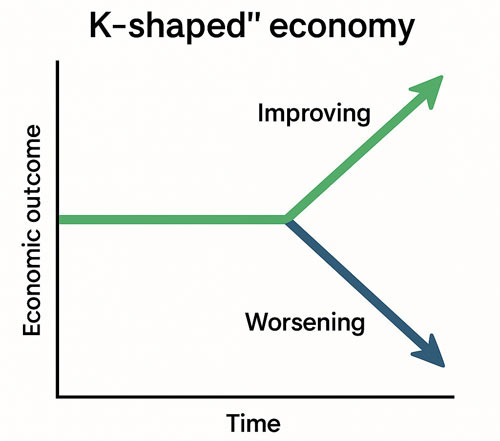
These days, looking at the U.S. economy, they say it is called a K-shaped economy.
This means that those who are doing well are getting better, while those who are struggling are finding it increasingly difficult. If you look at the K shape, there are parts that go up and parts that bend down, right? It's exactly that shape.
The upper line of the K represents the wealthy. Their income is steadily increasing through investment returns, and their consumption is vigorous. On the other hand, the line that bends down represents the low-income and middle-class. Inflation is still high, housing prices are unaffordable, credit card debts keep piling up, and insurance premiums are exorbitantly expensive. It's no wonder that people feel overwhelmed just trying to get by.
In fact, this polarization is not a recent issue. The gap that has been widening since the 1980s began to grow significantly after COVID-19. Mark Zandi, chief economist at Moody's Analytics, stated, "The gap between the rich and the rest is now completely out of control."
The reason this is happening is that the top 10% of people account for nearly half of all consumption. This figure was reported for the second quarter of 2025. It has always been the case, but now it is at an all-time high. In contrast, the consumption growth rate of the lower-income group was only 0.6%. The upper-income group saw a 2.6% increase. This difference is widening more and more. The luxury market in the U.S. has also grown by 8%.
Who is spending like that? Older, wealthier people. Meanwhile, young people with little money are in a situation where they have to save and save.
The stock market is similar. These days, stock prices are rising continuously thanks to the AI boom, but most of the profits are going to the top 1%. They hold nearly half of all stocks and funds. According to a Gallup survey, 87% of stockholders come from households with an annual income of over $100,000.
Of course, regular workers also have investment products like 401(k)s. However, for low-income individuals, this may sound like a story from another country. Tuan Nguyen, an economist at RSM, said, "For people barely getting by on their salaries, the stock market boom doesn't resonate with them." Rather, the prices of groceries and rent are much more immediate concerns.
Wages have also diverged. The upper class saw a 4% increase in wages. However, low-income individuals only saw a mere 0.9% increase. This is reportedly the lowest figure since 2016. This is really too much.
Moreover, the wealthy have less debt or can manage it, while ordinary people are burdened with credit card debt, student loans, and home mortgages. The job situation is also serious; low-income individuals are finding it increasingly difficult to secure jobs once they lose them.
Ultimately, this is a structure where only a few people are benefiting. And within that structure, the rest are being pushed closer to the edge. Sadly, this seems to be the reality we are living in.






 Bacon King Blog |
 Bald Eagle Brothers |
 Seattle - Emerald City |
 PETRO Vatican Shrine |
 Real Estate Agent USA |
  DREAM BIG |
  frostbite |
  330 Forever My Love |
  El Dorado |
  dralix58 |
  Gorama Round |
  Skydiving |
  dreamport |
  Yellow Snowman |
  Toaster Pizza Magic Show |
  velvetnom |
  Anytime Journey |
  Mrs. Duluth |
  jaxter |
  Atlanta Mama |
  Baguette Blog |
  Tan Sol |
  US Embassy |
  Korean Mom |
  My NYC |