

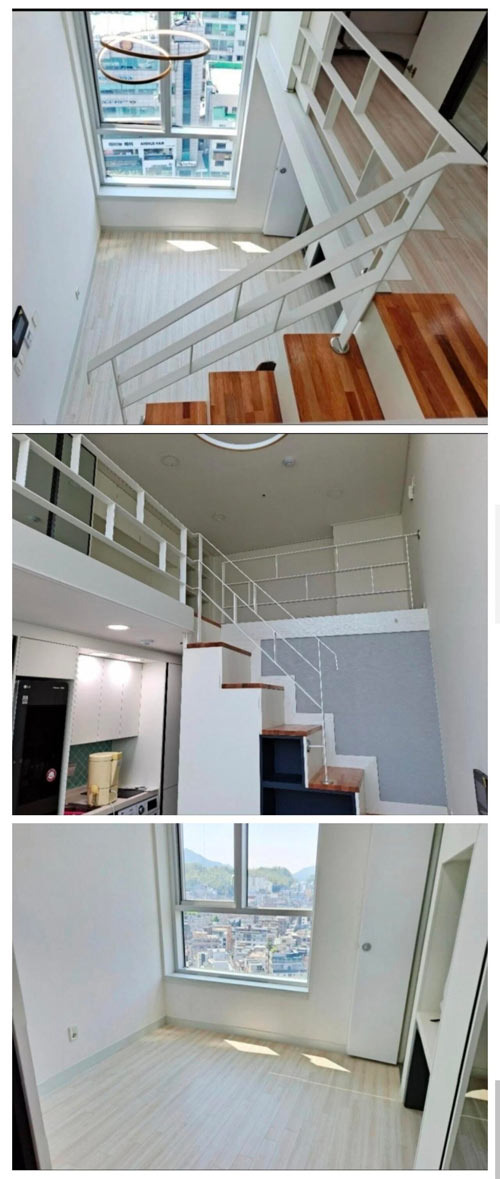
It's a 3-pyeong happy house in Gwanak-gu, Seoul, with a deposit of 25 million won and a monthly rent of 100,000 won.
When I first saw this photo, I thought my American friends would have one of two reactions.
"Wow, can people really live there?"
Or
"At that price, I'd sign a lease right away."
This is a happy house in Gwanak-gu, Seoul.
The area is about 3 pyeong, which is roughly 10 square meters, or about 108 square feet in American terms.
Speaking in American terms, 108 square feet... haha, there are hardly any examples of apartments being offered as independent living spaces.
In high-density cities like New York, San Francisco, and Boston, there are legal minimum living space requirements.
Of course, there are small spaces in the U.S. But most are room rentals where you rent a single room.
For example, college students might share a 4-bedroom apartment with friends or rent a room in a single-family home.
In other words, there are almost no independent housing concepts that include a bathroom, kitchen, living room, and loft space like in the photo.
From that perspective, this space is likely to seem fascinating to Americans.
But what's even more surprising is the price.
A deposit of 25 million won.
Calculating the current exchange rate at about 1,500 won per dollar, that's roughly $18,500.
The monthly rent of 100,000 won is about $74.
If I explained this to Americans, they might say:
"You're putting down $16,500 and only paying $74 a month to live in Seoul?"
This is almost an alien contract structure to Americans.
Because in the U.S., the deposit is usually about one month's rent.
If rent in L.A. is $2,500 a month, the deposit is also $2,500.
In the past, some landlords required more than two months' rent, but after recent changes in California law, most now require just one month's rent.
So, an $18,500 deposit is already a significant amount.
However, from an American's perspective, let's assume someone in Manhattan is paying $2,000 a month in rent.
That's $24,000 a year. $48,000 over two years.
In contrast, with a happy house, you put down $18,500 and only have to pay $74 a month.
If you're living there long-term, the total housing cost difference becomes enormous.
So, if this system is introduced to college students or young professionals in major U.S. cities, many are likely to show interest.
Especially those in their 20s who have just graduated and are struggling with housing costs.
It's common for a new engineer in San Francisco to pay $2,500 to $3,500 for a studio.
The same goes for New York.
In that context, the concept of "a large deposit but almost no rent" can seem quite attractive.
However, there's also a point where Americans might hesitate.
That's the initial capital.
Many American college students graduate with student loans.
Coming up with $18,500 right away is not easy.
So, while the rent burden is low, they may feel the entry barrier is high.
Another issue is the space.
In Korea, the concept of "even 3 pyeong is an independent space like my own home" is somewhat accepted.
In contrast, American culture has much higher expectations for space.
If you show this photo to people in Texas or Arizona, they might joke, "Isn't that a storage unit?"
This is because in some areas of Texas, you can find 600 to 800 square foot apartments for around $800 to $1,000 a month.
So, overall reactions in the U.S. will vary.
Residents of high-cost cities like New York, Boston, San Francisco, and Seattle are likely to say, "I'd move in right away."
On the other hand, people from places like Texas, Ohio, Indiana, and Arizona might feel the space is too small.
Interestingly, the jeonse system in Korea is gradually decreasing.
As interest rates rise and the real estate market changes, it has become difficult for landlords to generate income from large deposits.
However, Americans will probably add one last comment.
"The price is good, but... where would you put the sofa?" 😅
 PuddingVibe
 WeatherNews







 moo moo |
 ultron78 |
 garlic bread |
 Sugar Cream Door Bulletproof Noodles |
 urbanmint |
 Weekend Movie Blog |
 Superman Cat Blog |
 Victory 1988 |
 Beauty, Health, Lifestyle Blog |
 Valley Hong |
  hot chocolate |
  SODA MAKER |
  james kim |
  All About Cars |
  lomira98 |
  calmbridge |
  oneonly |
  Brighto |
  racuse |
  Total Beauty |
  crystal |
  Good Hotels |
  raspberry7 |
  Que que |
  Well Done Sir |
  dance dance |
  sweetpepe |
  vegas mom |
  Olivia's Blog |
  cathywhite |