
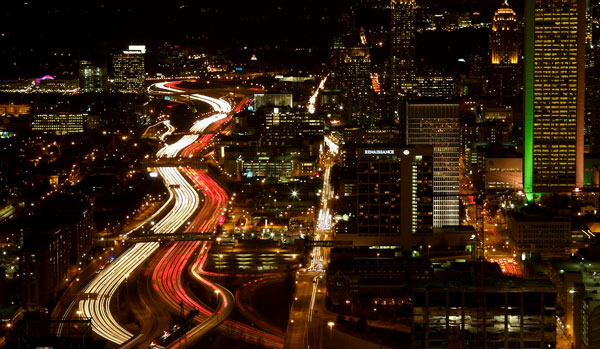
Looking at the population composition of Atlanta, it is evident that, as a key city in the southern United States, the Black community forms the economic and cultural center, not just in terms of numbers but as a driving force of the city's identity.
As a result, Atlanta has a noticeably higher number of Black professionals, entrepreneurs, and politicians compared to other American cities, earning it the nickname "modern Black city." Conversely, as one moves away from the city center, the White population increases, and the suburbs see a mix of Hispanic and Asian communities. In other words, downtown has a strong Black urban atmosphere, while the northern suburbs lean towards a multicultural, middle-class vibe.
Although the Asian population is not a large percentage of the total, it has been growing rapidly and has a significant presence in education and the IT and engineering sectors. The Hispanic population is also steadily increasing, with the logistics, construction, and service industries gradually expanding their market presence. This city is very much job-centered, and it is characteristic that the racial composition is continuously changing due to incoming migrants. In short, Atlanta is not a city of a specific race, but a place where diverse people come for economic opportunities, renewing the city's atmosphere.
So, what about safety and crime rates? In a nutshell, Atlanta can be described as "the city center requires caution, while the suburbs are quite safe." Compared to other major cities, violent incidents are not particularly high, but due to clear income disparities, the perception of safety varies significantly by area. Particularly near downtown, in areas where foot traffic decreases at night, and around public transport stations, incidents such as pickpocketing, robbery, and car theft occur frequently. It is advisable for travelers to avoid walking in unfamiliar areas late at night.
However, that does not mean the entire city is dangerous. Surprisingly, Atlanta residents joke that "as long as your car isn't stolen, everything is fine," highlighting the prevalence of car-related crimes. Leaving car doors unlocked in parking lots or placing bags and electronic devices in plain sight can make one a target. Therefore, locals have developed the habit of not leaving any belongings in their cars.
On the other hand, northern suburban areas, such as Buckhead, Sandy Springs, and Alpharetta, have a higher population of middle-class and professional residents, making safety much more stable and the living environment cleaner. The quality of schools is high, and the commercial areas are well-developed, making these places preferred by families with children. Interestingly, many people work in the city center but choose to live in the suburbs. In a way, Atlanta can be described as a city where "work is in the city center, and life is in the north."
Ultimately, the racial composition of Atlanta itself creates the energy of the city. The combination of a historically Black cultural center and modern industries creates a unique charm, and as migrants continue to flow in, diversity is increasing. Safety cannot simply be labeled as dangerous; it presents completely different faces depending on where one chooses to go.
Judging Atlanta solely by its city center would result in a partial evaluation. The downtown area is a vibrant battlefield, while the suburbs are stable living spaces. It is this coexistence that I believe allows Atlanta to continue growing.








 Cherokee Rose |
 Dingho and USA News |
 moonshine 7 |

 Gimmi207 Blog |
  US Embassy |
  Korean Mom |
  My NYC |
  moo moo |
  Mr Oh |
  forevergee |
  festival |
  manchester |
  constant |
  Leapfrog Move |
  vibranto |
  Tora Tora |
  yellowbutter |
  Dolly |
  NYC saladbar |
  Finding Superfoods |
  lightyear |
  song bang |
  vexomo |
  Indiana Jones |