

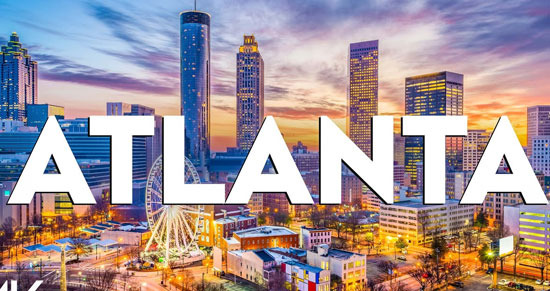
Georgia's Atlanta sometimes gives the impression of being a coastal city just from its name. However, this city is located far from the coast in the southeastern interior of the United States.
The history of Atlanta begins with the railroad. In the 1830s, plans for a railroad crossing the southeastern United States were initiated, and a location was chosen near present-day Atlanta to serve as a hub for the intersecting rail lines. Initially, this area was simply a railroad terminus, and its name was rather stiff. It was called 'Terminus,' which literally means 'end point.'
As the city grew, there was a search for a more refined name than the somewhat unappealing Terminus, and it was briefly referred to as 'Marthasville.' However, this name did not last long either.
Then, among the officials of the Georgia Railroad Company overseeing the railroad construction, there was a call for a more symbolic name, and ultimately, the name 'Atlanta' was created by taking 'Atlantic' from one of the rail lines, the 'Western & Atlantic Railroad,' to convey a more feminine feel.
Perhaps due to this background, Atlanta naturally carries the image of being a 'city of connections.' It is also known as the gateway to the South, and Hartsfield-Jackson Atlanta International Airport is considered one of the busiest airports in the world, making it a hub for air travel.
When Americans talk about Atlanta, the typical images that come to mind are that of the 'capital of the South' and a 'center of aviation and business.'
Thanks to the fact that it is a city with the busiest airport in the world, Atlanta strongly holds the image of being a center for travel and logistics. At the same time, it is home to global brands like Coca-Cola and CNN, giving it a sophisticated metropolitan feel among Southern cities. Additionally, it is a place with a strong influence of Black culture, characterized by the vibrant growth of hip-hop music, the entertainment industry, and Black middle-class culture.
Those who view this positively assess it as a 'city of diversity and opportunity,' while others associate it with traffic congestion, hot weather, and the chaos of rapid population growth, leading to an image of a tiring city. Ultimately, Atlanta is not just a simple Southern city but is strongly recognized as a modern city that is reshaping the identity of the American South.
In the end, the name Atlanta has always carried the meaning of 'connection' from the start, and it seems to have realized that image today.






 Cherokee Rose |
 Dingho and USA News |
 Korea Tiger News |
 moonshine 7 |
 DREAM BIG |
  frostbite |
  330 Forever My Love |
  El Dorado |
  dralix58 |
  Gorama Round |
  Skydiving |
  dreamport |
  Yellow Snowman |
  Toaster Pizza Magic Show |
  velvetnom |
  Anytime Journey |
  Mrs. Duluth |
  jaxter |
  Atlanta Mama |
  Baguette Blog |
  Tan Sol |
  US Embassy |
  Korean Mom |
  My NYC |