

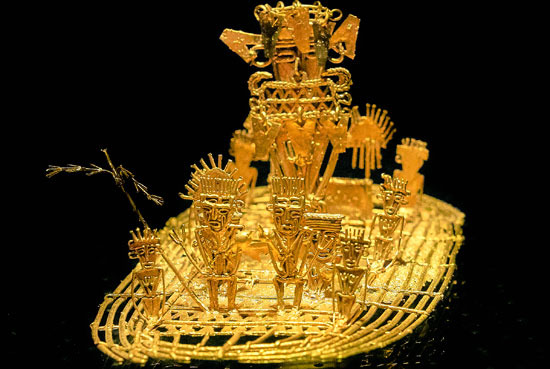
Was the legend of El Dorado, a city made of gold hidden somewhere in the South American jungle, real?
It might be dismissed as just a story from the past, but surprisingly, it has clear roots as a legend.
The Muisca people, who lived in the highlands of present-day Colombia, would cover themselves in gold dust and perform rituals in the middle of a lake when selecting a king or conducting important ceremonies. They even threw entire gold ornaments into the lake as offerings to the gods, which must have astonished the European explorers when they heard this story.
For Europeans, gold was a symbol of wealth. However, hearing tales of people bathing in gold and throwing it into the water naturally led to the imagination of a 'king covered in gold and a city of gold piled high.' Thus, the land of gold, El Dorado, grew into a massive fantasy.
The problem is that no such city has ever been found. For hundreds of years, countless explorers have wandered through jungles and crossed mountains, but the golden city of legend has never been discovered. Instead, many lost their lives to hunger, disease, tropical climates, venomous snakes, and pests. There are countless stories of those who set out in search of gold but vanished without ever seeing it.
One important point here is that gold was not a 'symbol of wealth and display' for the indigenous people as it was for Europeans. It was a sacred offering to the gods and held religious significance. European explorers, unable to understand this difference, ended up overlaying their own greed onto the legend, imagining a larger and more magnificent city of gold.
That said, it doesn't mean there was no gold in South America. In fact, South American civilizations had excellent goldsmithing skills, and there was a good possibility that a significant amount of gold existed in certain areas.
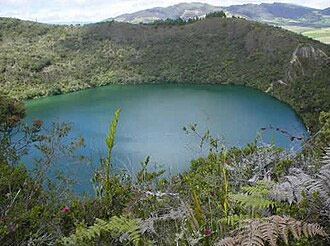
One frequently mentioned location is Lake Guatavita. This volcanic crater lake, located at an altitude of 2,700 meters, is known as the core site of the El Dorado legend. Stories have been passed down that the Muisca people offered gold and washed off gold dust here, leading explorers to believe that immense treasures were buried beneath the lake.
As a result, there have been several attempts to drain the lake, digging canals or installing equipment to reveal the bottom. However, due to deep mud and complex terrain, these efforts repeatedly failed and only harmed the lake's ecosystem.
Ultimately, the Colombian government designated the lake as a protected area, banning all exploration. From that moment on, the treasure of Guatavita became a legend that sparkled only in human imagination, rather than something that could be found in reality.
In the end, it is more reasonable to view El Dorado not as a real city made of gold, but as a legend created by the exaggeration and embellishment of actual customs and the existence of gold. The hidden civilizations in the jungle, the rituals conducted with gold, and the surrounding human greed all mixed together to give rise to the imagination of a 'golden city.'
The name El Dorado began in South American legend but has survived in a completely different way in the United States.
After the westward expansion, it came to be seen as a symbol of 'prosperity' and 'discovery,' widely used in city names, hotels, casinos, cars, movie theaters, and shopping malls. Notably, California has an El Dorado County, which emphasized the image of "the land of dreams of wealth" combined with the gold rush image.
Many casinos and resorts in the U.S. also enjoy using this name to create an atmosphere of "opportunity for luck and gold" for their guests. Ultimately, in the U.S., El Dorado has been reinterpreted not as a real city of gold, but as a symbol of success that one might dream of, becoming a part of everyday branding.






 Cherokee Rose |
 Dingho and USA News |
 moonshine 7 |

 Gimmi207 Blog |
  Korean Mom |
  My NYC |
  moo moo |
  Mr Oh |
  forevergee |
  festival |
  manchester |
  constant |
  Leapfrog Move |
  vibranto |
  Tora Tora |
  yellowbutter |
  Dolly |
  US Embassy |
  NYC saladbar |
  Finding Superfoods |
  lightyear |
  song bang |
  vexomo |
  Indiana Jones |