

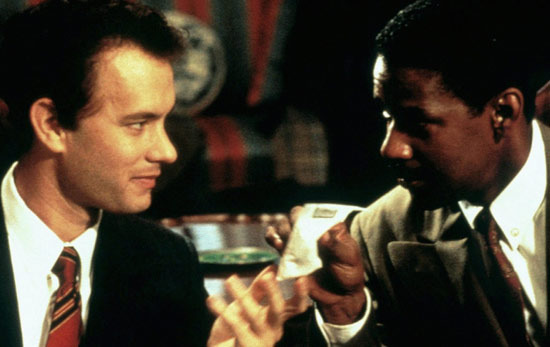
The film Philadelphia, released in 1993, was a groundbreaking Hollywood film that directly addressed AIDS and discrimination against homosexuality for the first time in history.
Directed by Jonathan Demme, it starred Tom Hanks and Denzel Washington.
This film tells the story of lawyer Andrew Beckett, who, after being wrongfully fired due to his AIDS diagnosis, fights his case in court, making a courageous social statement for its time.
Tom Hanks portrayed Andrew Beckett, who gradually weakens due to AIDS but continues to fight for his rights, winning the Academy Award for Best Actor at the 66th Academy Awards in 1994.
The following year, he won the Academy Award for Best Actor again for Forrest Gump, setting an unprecedented record of consecutive wins.
Denzel Washington also delivered an excellent performance as Joe Miller, a lawyer who initially holds prejudices against homosexuality but gradually changes his perspective.
As the film is titled after the city, it was filmed throughout Philadelphia. The courtroom scenes were shot in the Philadelphia courthouse, and the scene where the protagonist organizes his office was filmed in an actual office building in downtown Philadelphia.
Notably, an emotional scene where Andrew Beckett searches for legal books was filmed at the Free Library of Philadelphia. The city's landscape, filled with historic buildings, is naturally integrated throughout the film.
The film's theme song, "Streets of Philadelphia" by Bruce Springsteen, also gained significant popularity.
This song won the Academy Award for Best Original Song in 1994, with lyrics that resonate deeply with the struggles of those fighting AIDS, touching many hearts.
The film and its theme song together convey a social message of the era, contributing to the changing perceptions of AIDS and discrimination against the LGBTQ+ community in American society.
Philadelphia goes beyond mere entertainment, addressing various themes such as law, human rights, healthcare, and social justice in depth.
While it may seem like a given from today's perspective, the message conveyed by this film was very progressive and courageous in the context of the societal atmosphere of fear and misunderstanding surrounding AIDS in 1993. It serves as an important historical cultural artifact for understanding the changes in American society in the early 1990s.
Living in Philadelphia and watching this film allows one to recall the filming locations throughout the city, adding a special emotional resonance.
The Free Library, courthouse, and downtown streets depicted in the film still exist today, making it a meaningful experience to visit the actual locations after watching the movie.
Like the city name Philadelphia, which means "brotherly love," this film carries a message of respecting the dignity and rights of all people, regardless of race, gender, or sexual orientation.



 Iowa Egen Aunt |
 Beauty, Health, Lifestyle Blog |
 Always Atlanta |
 RV Samuel's Dad |
 Ham and Cheese |
 DelphiaMo |
 Texas Migration Story |
 Good World Good Thoughts |
 Pennsylvania Information News |
 Mr Cleveland |
  Sugar Cream Door Bulletproof Noodles |
  novapixel |
  lavender |
  macan 08 |
  Goroke Geureoke News |
  colo colo |
  U.S. Weather Bureau News |
  Dragon Lee |
  American Food Information & Calories |
  zephyrs |
  ness 6 |
  Montgomery Mom |
  SteelOrbit |
  Puddle Puddle |
  Arizona Cowboy |
  macaronpop |
  marydock |
  peachpanda |
  U.S. College Admission Information |