

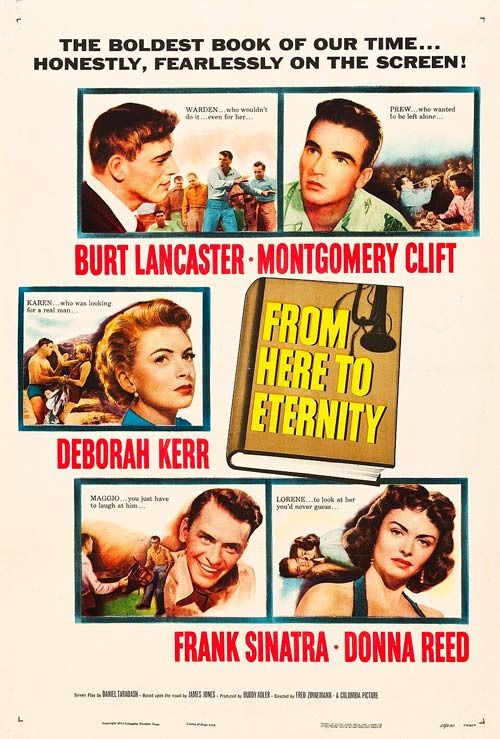
The film From Here to Eternity features a memorable scene where characters kiss while lying on the beach, with waves crashing around them.
In Korea, it is known by the famous title '지상에서 영원으로' (From Earth to Eternity), and it is rare for a single kiss scene to be remembered for so long in film history.
Produced in 1953, From Here to Eternity was directed by Fred Zinnemann.
This director was already well-known for films like High Noon and The Nun's Story, and he brings his signature heavy direction to this work.
The cast was quite impressive for its time, featuring Montgomery Clift, Burt Lancaster, Deborah Kerr, Donna Reed, and Frank Sinatra in leading roles. Additionally, Ernest Borgnine, who was relatively unknown at the time, also appeared, paving the way for his future career.
However, the true essence of this film lies in its historical context.
Set in 1941, it depicts the U.S. military stationed in Oahu, Hawaii, observing World War II. While life seems peaceful and leisurely, an underlying tension exists.
This is because it takes place just before the attack on Pearl Harbor, and the characters in the film live their lives unaware of the impending events. This adds a layer of realism and a strangely heavy atmosphere.
The main cast is quite star-studded. Burt Lancaster, Montgomery Clift, Deborah Kerr, and Frank Sinatra all appear.
Particularly, Sinatra's life was completely transformed by this film. At the time, his popularity as a singer was waning, but he won the Academy Award for Best Supporting Actor with this role, marking his resurgence as an actor. Such cases are rare in Hollywood.
The greatness of this film lies not in depicting war itself, but in showcasing the lives of people just before it.
Conflicts within the military, issues between superiors and subordinates, and personal love and desires build up and eventually explode all at once.
Thus, when the Pearl Harbor attack occurs at the end, it feels like not just a simple event, but a culmination of all the stories that have been building up.
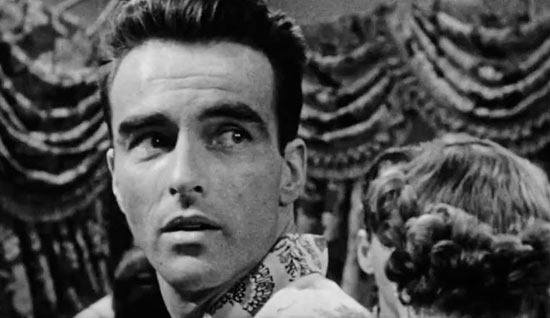
The filming locations also hold significance. The scenes shot in Halona Cove, Oahu, Hawaii, have become tourist attractions to this day.
However, knowing that this was a space filled with military tension at the time changes the perception of it.
The box office performance was also quite impressive. Made with a budget of about $2 million, it grossed approximately $12.5 million upon release, achieving great success, and ultimately recorded about $30.5 million in revenue.
This level corresponds to the second highest box office performance in 1953.
Critically, it received high praise, sweeping major categories at the 1954 Academy Awards, including Best Picture, Best Director, Best Supporting Actor (Frank Sinatra), Best Supporting Actress (Donna Reed), Best Cinematography (Black and White), Best Film Editing, Best Sound, and Best Screenplay, making it the most awarded film of that year. Even by today's standards, this is an incredible achievement.
In Korea, it has consistently been mentioned among TV broadcasts, re-releases, and among film fans, establishing itself as a classic film.
If I were to sum up my feelings after watching this film, I would say it is not a movie famous for its "kiss scene." The real essence lies in the underlying atmosphere of the era.
It tells the story of people living their lives unaware, suddenly thrown into the midst of history. Therefore, after watching, it leaves a strange feeling in the heart.
For those who only think of Hawaii as a vacation spot, watching this film will change that perspective. Even in the same location, the stories embedded within it feel different. The scene where Montgomery Clift plays a trumpet in memory of a fallen comrade leaves a strong emotional impression, while the scene of Burt Lancaster and Deborah Kerr kissing on the beach has become one of the most famous scenes in film history.
This scene has been parodied in various works, appearing in altered forms in films like Shrek 2 and Airplane!
Thanks to the recognition of the lead actors, this film is relatively well-known in Korea. Despite being a classic film, it continues to be mentioned among film fans and has established itself as one of the representative works of classic Hollywood cinema.
Such films seem to endure even without flashy action. Ultimately, films tell the stories of ordinary people and the times they live in.
 KawaiiPieBeam
 YogurtPuzzle
 HeartPopper
 PeterPedro






 Iowa Egen Aunt |
 Beauty, Health, Lifestyle Blog |
 Always Atlanta |
 RV Samuel's Dad |
 Ham and Cheese |
 Unknown Dog Walk blog |
 Hawaii Fox |


 silverado |
  Conflite Teacher |
  summita |
  Ari Songhan American Immigration Life |
  marketbox |
  Investment Campus Home Ownership |
  yentra |
  donut33 |
  gravity |
  American Golf Course Travelogue |
  There Are Such Things in the World |
  Agenda Center |
  digital |
  timemachine |
  Starry Eyes |
  Desert King |
  Texas Real Estate Blog |
  U.S. Retirement Pension Information |
  Seattle - Emerald City |
  Texas Migration Story |