

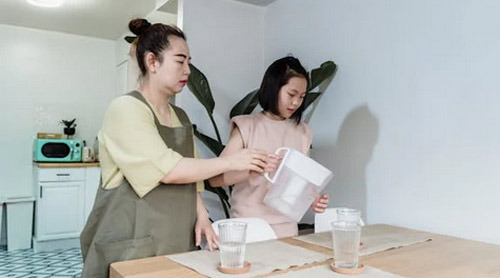
It has already been 3 years since I moved from New York to Dallas, Texas. Honestly, I didn't think much about the tap water here.
But once I got here, I realized, oh... the taste of tap water can be this different.
When I lived in New York, I honestly just drank the tap water. New York's tap water comes from clean sources in the Appalachian Mountains, and it is soft with almost no smell. The water tastes so clear that I didn't notice much difference when making coffee or tea. Because of that, I didn't use the Brita filter much and only occasionally used it when brewing tea.
However, when I came to Dallas and immediately poured myself a glass of water... I could distinctly smell a strange earthy scent and a bit of chlorine.
Later, I found out that Dallas's tap water is primarily sourced from rivers and lakes (notably Lake Ray Hubbard and Lake Lewisville) rather than groundwater like New York.
Since it is surface water rather than groundwater, the taste and smell can vary more significantly depending on the season, temperature, and algae growth.
Especially in the summer, algae growth becomes active, intensifying the earthy and grassy scent known as 'geosmin.'
During times when more chlorine is used for disinfection, the chemical smell also becomes quite pronounced.
So, I immediately pulled out my Brita filter. Brita uses activated carbon and ion exchange resin to filter out chlorine smell, some metal components, and unpleasant tastes.
In Dallas, this filter felt almost like a necessity. After filtering, the taste of the water becomes much smoother and the off-flavors are reduced.
However, Brita doesn't solve everything. Brita is not a perfect water purifier that completely filters out bacteria, and its ability to remove heavy metals is limited.
But it is indeed effective in improving the taste and smell of tap water.
Across the United States, there are areas where Brita is essential and areas where it is not necessary.
For example, places like New York, Seattle, and Portland have water sources in mountainous areas, resulting in relatively clean water quality and good taste, so many people drink comfortably without Brita.
In dry areas like Texas, Arizona, and Nevada, surface water from rivers and lakes is primarily used, and the taste can change during long-distance transport or have a strong disinfectant smell.
In such places, filters like Brita greatly help improve the taste of water. Additionally, in areas like Flint, Michigan, where old pipes pose a risk of lead contamination, it is safer to use filters specifically designed for heavy metal removal or reverse osmosis (RO) purifiers rather than Brita.
In conclusion, in my life in Dallas, Brita plays a significant role as a 'water taste restoration device.'
Whether making coffee in the morning or filling my children's water bottles, it is much more satisfying. An item that was not necessary in New York has become an essential part of my life here.
If the taste of the water bothers you, I recommend starting with a filter like Brita.
It doesn't cost much, and the water you drink every day becomes much more enjoyable.







 eatontown blog |
 Toaster Pizza Magic Show |
 US Embassy |
 fortbliss |
 Folding Instructions |
 xylora |
 wendra |
 Aura-Infused WACAM |
 Texas Migration Story |
 There Are Such Things in the World |
  Tonky |
  viroma |
  cookie |
  Live and that's it |
  Alright Twain |
  HAWAII Korean Church News |
  Amore |
  linex |
  Balancework |
  laro90 |
  MEDBIO American Doctor Blog |
  SWAT TEAM BLK |
  DREAM BIG |
  frostbite |
  330 Forever My Love |
  El Dorado |
  dralix58 |
  Gorama Round |
  Skydiving |