

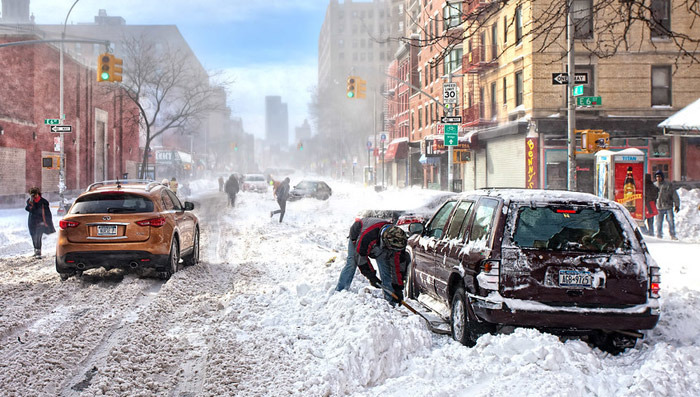
The first shock I experienced while living in New York was the cold.
These days, every time I endure a cold winter, I often wonder if living in such a cold region makes it hard to live long.
First, living in a cold region makes you reluctant to go outside every winter. The battle begins the moment you start the car. As soon as you sit in the seat, your butt feels like it's on ice, and who would want to go out and exercise? Lack of exercise quickly follows, and eventually, your belly starts to grow, blood pressure rises, and cholesterol builds up. The doctor says, "At least go for a walk," but who wants to walk on a day when the wind is blowing at minus 20 degrees?
Second, the cold changes what you eat. Strangely, when the weather is cold, you crave greasy and salty foods. Someone who could survive on salads in the summer suddenly craves stews, cheese, bacon, and warm soup with bread in the winter. The problem is that all these foods are high in calories. My body has already stored enough emergency supplies, but I can't help but wonder if I'm mistaking myself for a bear that needs to hibernate.
Third, there's a lack of vitamin D. The days are shorter, and since I spend most of my time indoors, I don't get enough sunlight. My skin is getting paler, my bones are weakening, and my immune system is declining. The doctor recommends vitamin D supplements, but every time I open the bottle, I can only sigh, thinking, "This is all because I didn't move south."
Fourth, there's loneliness and depression. It's not easy to meet people when you live in a cold region. On snowy days, it's a hassle to meet friends, and I end up just watching Netflix alone at home. As a result, my social relationships weaken, and my mood shrinks. Depression is the biggest enemy of longevity. The fact that long winters can eat away at mental health is something you can feel after just a few years of living here.
Fifth, there's the risk of accidents. Falling on snowy or icy roads is common, and cars slip almost every day. You can injure your back from falling, and a car slipping can lead to serious accidents. Statistically, the colder the region, the higher the rate of winter fractures and traffic accidents. At this point, one might wonder, "Is it even possible to live long in a cold place?"
Yet, human nature is fickle; as soon as the weather warms up, I think, "This place is livable." Of course, when winter returns, I sigh again, asking myself, "Why on earth am I living here?" This seems to be the fate of those in cold regions.
The conclusion is this: living in a cold region in the U.S. is not just about battling the weather; it directly relates to health and longevity.
But humans are creatures of adaptation, so even while complaining, we endure.
As time passes, another year goes by, and I grow older. So, even if I don't live long, isn't it better to live at least somewhat enjoyably while complaining?






 newyorker 101 |
 Things to Do to Buy a House |
 U.S. Weather Bureau News |
 International Court |
 Lunch and Dinner Mexican Taco |
  Anytime Journey |
  Mrs. Duluth |
  jaxter |
  Atlanta Mama |
  Baguette Blog |
  US Embassy |
  Korean Mom |
  My NYC |
  moo moo |
  Mr Oh |
  forevergee |
  festival |
  manchester |
  constant |
  Leapfrog Move |
  vibranto |
  Tora Tora |
  yellowbutter |
  Dolly |
  NYC saladbar |