
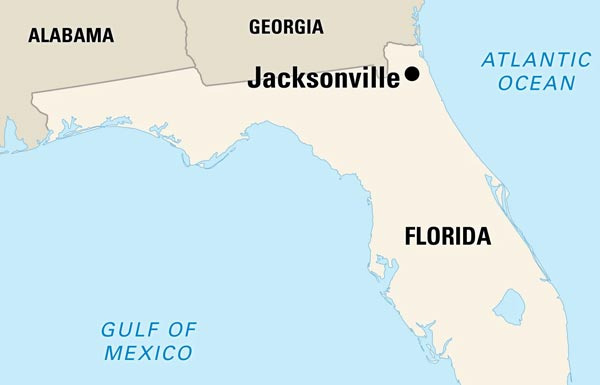
Jacksonville is one of the largest cities in the United States and ranks 12th in population among U.S. cities.
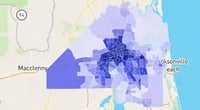
In terms of administrative boundaries, it covers an area of over 2,200 square kilometers, making it large enough to encompass several other cities.
The reason the city is so expansive is due to the merger of the city and Duval County in 1968. Therefore, Jacksonville includes not only the urban center but also suburbs, forests, and beaches as part of one city.
Geographically, Jacksonville is characterized by the St. Johns River, which runs through the center of the city. This river is one of Florida's iconic rivers, flowing unusually from south to north.
While most rivers in North America flow from north to south, the St. Johns River flows in the opposite direction and empties into the Atlantic Ocean. As a result, the downtown and port areas of Jacksonville, formed along the riverbank, have historically developed as centers of transportation and trade.
Jacksonville is also directly adjacent to the Atlantic Ocean, significantly influenced by a maritime climate. Summers are hot and humid, while winters are relatively mild. With average winter temperatures remaining above 10 degrees Celsius, it is considered a city where outdoor activities can be enjoyed year-round.
This leads to activities like golf, boating, fishing, and beach walks being part of daily life. Thanks to the climate, green trees and palm trees grow throughout the city all year round, adding to Jacksonville's tropical scenery.
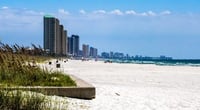
To the east of the city are beach areas such as Jacksonville Beach, Neptune Beach, and Atlantic Beach.
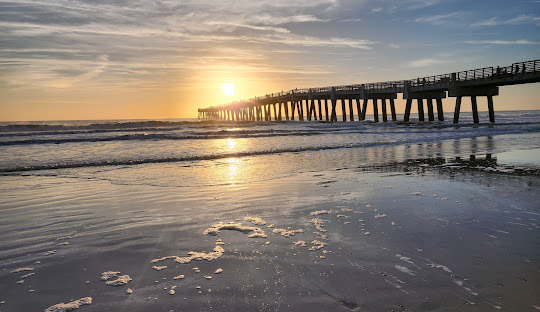
These areas are also famous as vacation spots, attracting family tourists on weekends. The coastline stretches over 20 miles with soft sandy beaches and gentle waves, always bustling with people enjoying surfing or beach volleyball.
In contrast, heading west and south from the city, the scenery changes completely. This area is rich in natural regions with pine forests, swamps, and numerous lakes, making it an excellent environment for camping and hiking. Within the city limits, there are several nature reserves and national parks.
To the north of Jacksonville, it borders the state of Georgia, and the Atlantic Coast Highway, I-95, runs through the downtown area. Following this road north leads directly to historic cities like Savannah or Charleston, making Jacksonville a gateway to northern Florida. Additionally, I-10 highway extends westward to Lake City and Texas, establishing it as a transportation hub connecting east, west, south, and north. The air, rail, and maritime transport networks are also well-developed, giving it strengths as a logistics center.
At the mouth of the St. Johns River lies the Jacksonville Port (JAXPORT), one of the most active trade ports in the southeastern United States. Automobiles, chemicals, and military supplies pass through here, contributing to the development of military bases and industrial complexes in Jacksonville. Nearby, the Naval Air Station Jacksonville also plays a significant role in the city's economy.
Thus, Jacksonville has a structure where the sea, river, forest, and city coexist within one region. Despite being a large city, it does not suffer from severe traffic congestion, and the ability to enjoy leisure in nature is a significant attraction. The coexistence of Florida's unique vacation atmosphere and urban convenience is what defines Jacksonville's geographical characteristics.




 Taco Bell Candy Note Blog |
 Mia Flori |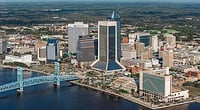


 Well Done Sir |
  dralix58 |
  Gorama Round |
  Skydiving |
  dreamport |
  Yellow Snowman |
  Toaster Pizza Magic Show |
  velvetnom |
  Anytime Journey |
  Mrs. Duluth |
  jaxter |
  Atlanta Mama |
  Baguette Blog |
  US Embassy |
  Korean Mom |
  My NYC |
  moo moo |
  Mr Oh |
  forevergee |
  festival |
  manchester |