

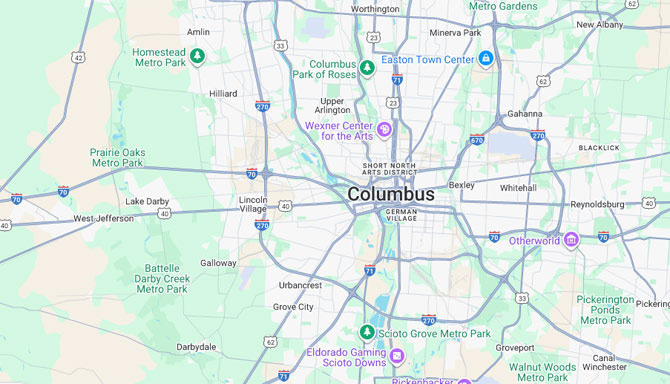
Columbus has several major freeways that run through the city.
This place is the administrative center of Ohio and a logistics hub, so highways extending in all directions are connected to this city. Therefore, it is a city where logistics movement is fast and convenient, but at the same time, there is considerable traffic congestion during rush hours.
The representative highway of Columbus is I-70. This road is a major highway that runs east-west across the United States, connecting westward through Indianapolis to St. Louis, and eastward to Pittsburgh and Washington D.C. It crosses downtown Columbus, where logistics trucks frequently pass. Therefore, traffic is heavy between 7 AM and 9 AM on weekdays, and between 4:30 PM and 6:30 PM.
In particular, the section where I-70 and I-71 intersect often experiences bottlenecks due to the mix of vehicles entering the city and those passing through. Next is I-71. This highway runs vertically through Ohio, connecting south to Cincinnati and north to Cleveland. It passes through the center of Columbus, making it one of the most used routes.
This road is mainly used by commercial vehicles and commuter traffic, making weekdays busier than weekends. In particular, the area near downtown known as the 'Split' is where I-70 and I-71 intersect, and it is considered the section with the highest traffic volume in Columbus.
The city authorities are currently conducting a large-scale construction project called the 'Downtown Ramp Up Project' to improve this section. As a result, it has become a more congested area due to construction vehicles and lane reductions for a while. Another important highway is I-270. This is a circular road known as the 'Columbus Beltline.' It is designed to encircle the city, frequently used by vehicles and logistics trucks trying to bypass the downtown area.
This road helps to disperse traffic congestion, but recently, as residential areas have expanded to the outskirts of the city, the northern section (Dublin, Worthington, Westerville) has become heavily congested during rush hours. In contrast, the southern and eastern sections are relatively less crowded. Especially at the intersections connecting I-70, I-71, and I-670, lane changes can be complicated, so first-time drivers should pay close attention to their GPS.
I-670 cannot be overlooked either. This road connects the airport (John Glenn Columbus International Airport) and downtown, but it has a high volume of traffic. Due to the influx of workers commuting to the airport, business travelers, taxis, and rental cars, traffic is often congested around 8 AM and 5 PM. However, this section has wide lanes and a well-coordinated signal system, making it relatively fast among the roads entering the downtown area. Traffic conditions are also affected by the seasons.
In particular, during winter, if it snows or icy roads form, congestion can last more than 1.5 times longer than usual. The Ohio Department of Transportation (ODOT) deploys snow removal vehicles in advance when snow is forecasted, but sudden snowstorms can quickly slow down the roads leading into the city. Conversely, in summer, it is road construction season, and many sections experience lane reductions, causing slowdowns.
During such times, drivers prefer to take the I-270 loop to detour. Interestingly, Columbus residents do not consider traffic to be a 'big problem.' It is not at the level of being stuck for hours like in New York or LA, and generally, delays are mostly around 20-30 minutes. Moreover, using personal vehicles is more common than public transportation, so most people adjust their commuting times slightly to avoid peak congestion.
In conclusion, the freeway structure in Columbus is efficient and well-designed to handle the city's growth rate. However, it is true that traffic in the northern outskirts is becoming increasingly severe as the population grows.




 moo moo |
 ultron78 |
 garlic bread |
 Sugar Cream Door Bulletproof Noodles |
 urbanmint |
 fixed |
  Ohio Ohayoung Hello |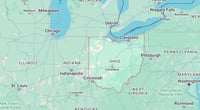

 DREAM BIG |
  frostbite |
  330 Forever My Love |
  El Dorado |
  dralix58 |
  Gorama Round |
  Skydiving |
  dreamport |
  Yellow Snowman |
  Toaster Pizza Magic Show |
  velvetnom |
  Anytime Journey |
  Mrs. Duluth |
  jaxter |
  Atlanta Mama |
  Baguette Blog |
  Tan Sol |
  US Embassy |
  Korean Mom |
  My NYC |