
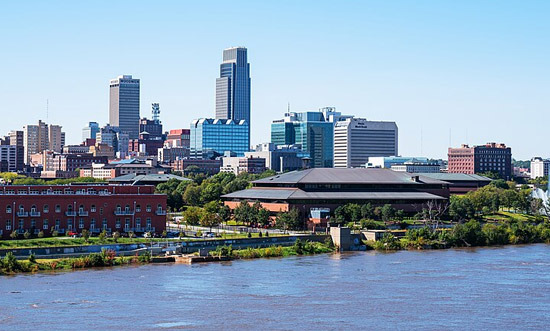
When talking about Omaha, Nebraska, people often picture flat cornfields and endless highways. However, once you visit Omaha, the city's atmosphere is quite different from that imagination. A river that flows slowly through the heart of the city completely changes Omaha's character. That river is the Missouri River. It is not just a waterway; it has shaped the personality and rhythm of life in the city of Omaha.
The Missouri River is one of the longest rivers in the United States, starting in northern Montana and flowing through the Midwest before joining the Mississippi River. Omaha is located on the western bank of this massive river. With the river acting as a boundary, Nebraska and Iowa are separated, and Omaha stands right on that border. Therefore, for the people of Omaha, the Missouri River is not just a landscape but a boundary, an entrance, and a living space.
In the past, the riverbank was not as clean and sophisticated as it is today. Old warehouses and industrial facilities lined the shore, and the river was treated merely as a backdrop for work. However, in the 2000s, the city began serious redevelopment of the riverfront, completely changing the atmosphere. At the center of this transformation is the Omaha Riverfront Park and the 'The Gene' area. This place is now one of the most vibrant spaces in downtown Omaha.
The boardwalk and walking paths along the river have become a daily route for Omaha residents. In the morning, joggers, dog walkers, and people sipping coffee while gazing at the river naturally blend together. Around lunchtime, office workers from nearby come out to sit on benches and eat their packed lunches, and as the sun sets, couples and families come out to take photos. The Missouri River flows at the center of all these scenes.
A symbolic structure of the riverfront is the Bob Kerrey Pedestrian Bridge. This unique structure allows people to walk between Nebraska and Iowa, with a main boundary marker in the middle. Taking a photo with one foot in Nebraska and the other in Iowa has become a small tourist attraction in the area. At night, the bridge lights up, and the sparkling lights on the river enhance the city's atmosphere.
As you move away from the river, downtown Omaha takes on a more traditional Midwestern city appearance, but near the riverfront, the vibe is completely different. Restaurants, bars, performance venues, art galleries, condos, and apartments blend together naturally. Especially in the summer, outdoor concerts and festivals are held almost every week, and the riverfront is used like a living room for the people of Omaha. This is where you feel the city breathing and moving around the river the most.
This riverfront development has not only created a visually appealing space but has also transformed Omaha's image. Once perceived as a quiet agricultural town and a logistics hub in the Midwest, it is now recognized as a mid-sized city alive with culture and leisure. The Missouri River is the stage and backdrop for that change.
The reason first-time visitors to Omaha say, "The city is more alive than I expected" is precisely because of this riverfront. There may not be a forest of tall buildings, but there is a stable rhythm where water, people, and space come together. Instead of the tension of a bustling metropolis, the city moves at a pace akin to the slowly flowing river.
Therefore, to understand Omaha, the quickest way is to walk along the Missouri Riverfront rather than just looking at a map. As you walk the boardwalk, feeling the breeze over the river, you will naturally sense the character of this city. Omaha is not just a city in the middle of the plains; it is a living city that has grown in harmony with the massive river it embraces.





 US Embassy |
 fortbliss |
 Folding Instructions |
 yentra |
 Cali M Law Group |
 selvon |
 moomoon |
  Nebraska Center Director TOP |
 Eagle in America for Five Years |
 Korean Mom |
  My NYC |
  moo moo |
  Mr Oh |
  forevergee |
  festival |
  manchester |
  constant |
  Leapfrog Move |
  vibranto |
  Tora Tora |
  yellowbutter |
  Dolly |
  NYC saladbar |
  Finding Superfoods |
  lightyear |
  song bang |
  vexomo |
  Indiana Jones |