

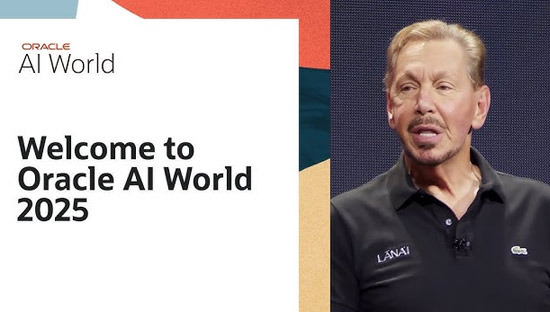
Today, the hot topic in the stock news was undoubtedly Oracle.
With the announcement of a surge in cloud contracts driven by skyrocketing demand for artificial intelligence (AI), Oracle's stock soared to its largest single-day increase in 33 years.
The stock jumped over 41% in just one day, reaching $341, and its market capitalization skyrocketed to $969 billion.
Thanks to this, co-founder Larry Ellison saw his net worth increase by $101 billion in a single day, surpassing Elon Musk to become the world's richest person according to Bloomberg. Of course, Forbes still claims Musk is number one, but it is undoubtedly a dramatic moment created by Oracle.
Oracle does not develop AI models directly; instead, it provides a platform that allows customers to operate the AI models they want based on cloud infrastructure. This has helped them secure reliability by collaborating with various AI companies.
Looking at the company's performance, it is even more astonishing. The remaining performance obligation (RPO) for cloud infrastructure contracts reached $455 billion, a 359% increase from the previous year, and this year's cloud revenue has grown by 77% year-over-year to $18 billion. The company projects it will grow to $144 billion within the next four years. Wall Street has described the results as "jaw-dropping," and major financial institutions have raised their target prices while maintaining buy recommendations.
So, is Oracle's remarkable success merely due to a few favorable news items? Or is it the result of building a model that is structurally aligned with the AI era? From a developer's perspective, Oracle's AI-based business model can be explained through five key strategies.
AI Infrastructure-Centric Multi-Cloud Strategy
Oracle does not develop AI models directly. Instead, it provides a neutral cloud infrastructure that allows various companies like Meta and xAI to run the models they desire. This has enabled them to expand their collaborative ecosystem and secure reliability without being dependent on a specific vendor. Notably, the $300 billion cloud contract with OpenAI over five years was a symbolic event that positioned Oracle as a key supplier of AI computing.
Explosive Cloud Revenue Growth
The demand for Oracle Cloud Infrastructure (OCI) has exploded due to the AI boom. This year alone, they have raised their revenue growth rate to 77% and plan to increase it to $144 billion within the next four years. Given that this is not just a short-term spike but a structural growth, investor expectations are understandably high.
Expansion of AI Services: Embedded and Custom AI
Oracle is integrating AI not just as a technical option but into its applications. Fusion Applications naturally include predictive analytics, generative AI, and AI agent functionalities, maximizing work efficiency. Additionally, the Custom AI platform helps enterprise customers design and deploy their own AI agents. This strategy supports models like GPT-4 and multimodal capabilities, achieving both customization and scalability.
Partnerships for Diverse AI Model Offerings
Oracle does not provide only specific models. They have broadened the options available on OCI by allowing access to various models like Google Cloud's Gemini and xAI's Grok. For customers, the ability to run "the AI they want from anywhere" is a significant attraction.
Massive AI Infrastructure Investment and Global Expansion
Participating in the Stargate project, Oracle is building next-generation AI infrastructure worth hundreds of billions of dollars alongside OpenAI and SoftBank, and has announced plans to invest $3 billion in Germany and the Netherlands over the next five years. They are not limiting themselves to the U.S. market but are pursuing global expansion.
Oracle is a "company that does not create AI models," but this very aspect has become its strength.
By focusing on providing the soil, that is, the infrastructure and ecosystem for nurturing AI, they have established a differentiated position from competitors. While AWS and Azure are attempting broad expansions, Oracle has precisely targeted the niche of being an "AI infrastructure specialist."
Of course, there are challenges ahead. Barriers such as the costs of expanding data centers, intensifying price competition, and regulatory risks exist. However, judging by the recent performance and market response, it seems likely that Oracle's remarkable success will continue for the time being.
There is a saying that AI is the new electricity. In that sense, Oracle is building a massive power grid that reliably transmits this electricity.
And that power grid is becoming wider and stronger.







 quanta7 |
 Living with a Consistent Heart |
 |
| 
 U.S. Weather Bureau News |
 Dallas Fort Worth DFW |
  DREAM BIG |
  frostbite |
  330 Forever My Love |
  El Dorado |
  dralix58 |
  Gorama Round |
  Skydiving |
  dreamport |
  Yellow Snowman |
  Toaster Pizza Magic Show |
  velvetnom |
  Anytime Journey |
  Mrs. Duluth |
  jaxter |
  Atlanta Mama |
  Baguette Blog |
  Tan Sol |
  US Embassy |
  Korean Mom |
  My NYC |