

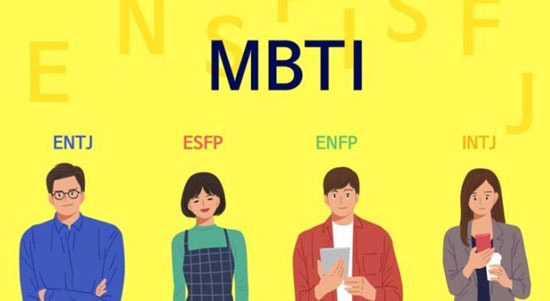
These days, when talking to people in their 20s, I hear the question "What's your MBTI?" at least once or twice.
At first, I was confused and thought, "What is MBTI? What does it stand for?" but now I automatically respond, "Me? ISFJ!"
In the past, when asking about someone's personality, it was about blood types, but now it starts with "Are you E or I?" and "Are you T or F?"
Previously, people were categorized by blood types, saying A types are timid, B types are self-centered, and AB types are genius types, but now they try to analyze every aspect of a person with a combination of four letters. We are now in the era of judging the world by MBTI.
Honestly, I was skeptical at first, but once you get into it, it's endless.
"Ah~ so that's why they acted that way!" and "Wow, this is totally my style!" I find myself looking into MBTI types as if reading a fortune.
The problem is that too many people have come to genuinely believe in it.
What started as a fun activity has turned into a way to judge people, with comments like "They're a T, so they'll act this way" and "They're a P, so they hate planning." At some point, I started hearing that "If you don't know MBTI, you're outdated"... Even dating apps have features that match people based on MBTI, making it almost a religion.
In fact, while MBTI is a theory created by psychologists, there are many ambiguous aspects that make it hard to consider it 'accurate' scientifically. Wouldn't it be convenient if people's personalities could be neatly divided into 16 types? But reality is not that simple. Some days I want to be quiet like an I, and other days I want to chat with friends like an E. Seeing myself change based on my mood makes me wonder, "Should I take the MBTI again?"
MBTI is merely a reference.
Moreover, as people age, their personalities change. Why don't people in their 50s and 60s care about MBTI?
Because life experience is more important. When I explain to older people, "E is extroverted, and I is introverted," they often respond, "So what?" They might even think, "Why are you studying useless things?"
However, among young people these days, not knowing MBTI can lead to being excluded from conversations.
At a gathering, someone might casually say, "Are you an N? I'm an S, so we won't get along lol." Hearing that is both funny and a bit bittersweet. Is it really necessary to divide like this? It's almost like a witch hunt for personalities when friends argue over things like, "You're a J, so you're inflexible."
Of course, MBTI is a great tool for conversation. Attempting to understand each other's tendencies is always a good thing. But believing it as an absolute standard is dangerous. People are influenced by countless variables that MBTI cannot explain: love, environment, upbringing, and even mood of the day. Isn't it cruel to say, "You're an INTP, so you'll definitely get dumped in a relationship"?
Personally, I think as long as MBTI remains a fun topic, it's fine.
But once you start labeling someone as "You are this kind of person," relationships become fixed, and the effort to understand each other is replaced by mere "analysis." And... most importantly, people change.
So the next time someone asks, "What's your MBTI?" I plan to respond like this.
"Me? I think like a T, cry like an F, plan like a J, and fail like a P."
Then that friend will probably laugh and say, "Oh, so you mixed a bit of ESTP with INFJ lol."
Yeah, that's about it... the fun of trying to understand, that's just right.







 Korean Mom |
 novapixel |
 Peter Pan Pet |
 horse |
 Sunset Oregon |
 leaves |
 gentle |
 midnight blue |
 Living in New Jersey blog |
 Atlanta Mama |
  Baguette Blog |
  US Embassy |
  My NYC |
  moo moo |
  Mr Oh |
  forevergee |
  festival |
  manchester |
  constant |
  Leapfrog Move |
  vibranto |
  Tora Tora |
  yellowbutter |
  Dolly |
  NYC saladbar |
  Finding Superfoods |
  lightyear |
  song bang |