

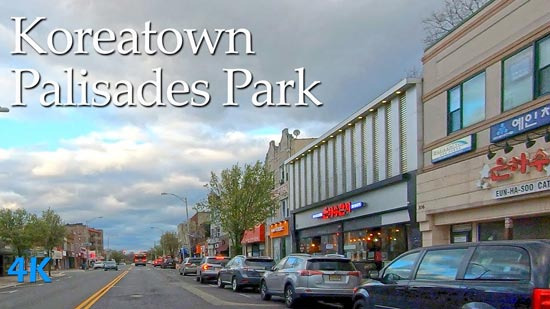
When talking about Palisades Park in New Jersey, it may seem like just a "nice neighborhood next to New York" or a "quiet residential area in New Jersey." It's located along the Hudson River and right next to Manhattan, so the location isn't bad.
However, this neighborhood is not that simple. First, it has a long history. It started in the mid-19th century, initially centered around agriculture and the lumber industry. It was, quite literally, just an ordinary neighborhood.
But in the 20th century, as transportation improved and access to New York became easier, things began to change. It started to transform into a "nice place to live." This is a common pattern seen in American neighborhoods.
The real change in atmosphere occurred in the 1940s and 50s. During this time, a significant Jewish community established itself here. This was not just a matter of "some immigrants coming in"; it fundamentally changed the character of the neighborhood. The effects of this are still felt today.
The population is about 25,000. By numbers alone, it seems like a small town. However, the density is quite high. The composition is also not simple. On the surface, it appears multicultural, but in reality, there is a strong influence from specific communities.
Interestingly, the term "multicultural" does not always mean the same thing. Palisades Park is diverse, but rather than balanced diversity, it has a structure where there is a center with other groups layered on top.
The median household income is around $75,000. In the context of New Jersey, that's not bad. It's just a "livable neighborhood." However, this is where some reality starts to show.
The average home price is about $600,000. What this means is that there is quite a burden of housing costs relative to income.
While it may outwardly appear to be a stable middle-class neighborhood, in reality, it is closer to a "survival structure."
The housing options are diverse. There are single-family homes, townhouses, and apartments all mixed together. However, in recent years, there has been continuous development pressure. Old homes are being torn down and rebuilt, and density is increasing. This trend is almost universally seen in areas near New York.
The reason this neighborhood is maintained is its location.
It has good access to Manhattan. It's a neighborhood where living in New Jersey while working in New York is possible. Therefore, demand continues to grow.
Education, safety, and amenities are also decent. This attracts many families.
Another important point is the strong community character.
This can be both an advantage and a disadvantage. While there is strong cohesion, it may not be easy for newcomers to adapt.
Ultimately, Palisades Park is an ordinary residential city on the surface, but underneath, its history, community, and economy are quite intricately intertwined, making it a "decent neighborhood" by today's standards.
However, the phrase "nice place to live" always comes with conditions. One must be able to handle the price, structure, and culture for it to be considered a "good neighborhood." Palisades Park seems to be just that case.



 Smile Face |
 Helpful Life Stories |
 Casa Mia |
 Study Abroad Life Know-How Tips |
 pravix22 |
 Margarine Daebimama |
 eatontown blog |
 Google Idea |
 yogurt mania |
 Okay Electronics Information |
  Hawaii Maui Kahului |
  calvorn |
  fernando park |
  newyorker 101 |
  coffeee |
  |
|  Christopher |
  sylven |
  Sammy Beach |
  Bliss O |
  blue ocean |
  greenlight |
  Watanaka Karametibaksa |
  castle |
  xelton52 |
  carefree |
  vrixen73 |
  AZ Road Master |
  Victory 1988 |
  summita |