
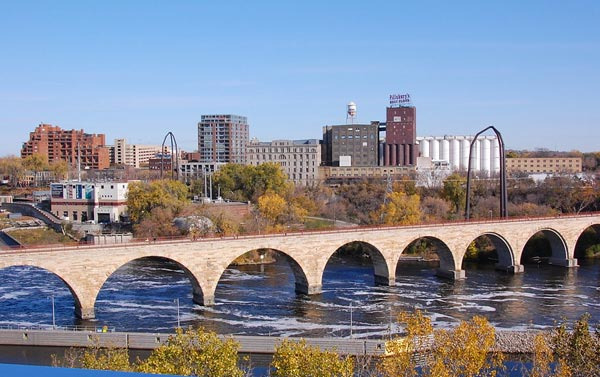
One of the iconic landmarks of Minneapolis is the Stone Arch Bridge.
This bridge symbolizes the history, industry, and rebirth of this place I call home, Minneapolis.
Spanning the Mississippi River, this bridge was completed in 1883, built by none other than James J. Hill.
He was a giant in the American railroad industry, known at the time as the 'Empire Builder.'
The Stone Arch Bridge was originally a railway bridge. James Hill aimed to connect St. Paul to the east and Minneapolis to the west, completing a massive railroad transportation network, with this bridge as the key route. Approximately 100,000 tons of stone were used, with a length of 2,100 feet (about 640 meters) and 23 arches, making it an impressive structure.
The texture of the stone and the curved structure create a sense of balance that is almost artistic even today. Interestingly, the Stone Arch Bridge is the only stone bridge crossing the Mississippi River. While most bridges are made of steel or concrete, this one is purely constructed of granite and limestone.
Thanks to this, it has stood the test of time for 140 years in its original form. Standing on the bridge, you can see the waters of the Mississippi River cascading down the St. Anthony Falls, with old mill buildings lined up beside it. This waterfall is also the reason Minneapolis is called the 'Mill City.'
By the end of the 19th century, the area became home to the world's largest flour mill, Washburn-Crosby (now General Mills), and the Pillsbury factory, making Minneapolis a center for flour export worldwide. The Stone Arch Bridge played a vital role in that industry. However, by the 1970s, as rail traffic declined, the bridge fell into disuse.
The tracks were removed, and it was left abandoned for several years. Then in 1994, the Minnesota state government and city authorities restored the bridge, transforming it into a pedestrian and bicycle bridge. Now, it has become a walkway for people rather than cars or trains, bustling with tourists, joggers, and couples taking photos on weekends.
Especially at sunset, the view of the Mississippi River and the downtown skyline from the bridge is truly breathtaking. The red stone reflects the sunset light, turning golden, with the IDS Tower and U.S. Bank Stadium silhouetted in the distance. In the summer, jazz festivals and marathons are held along the riverbank beneath the bridge, and it is also famous for fireworks on July 4th, Independence Day.
Interestingly, at one end of the bridge is the Mill City Museum, converted from the old Washburn flour mill. Here, you can learn about the industrial history of Minneapolis, and walking next to the Stone Arch Bridge connects the past and present in one glance. It is a great example of a historic building that has not only been preserved but has also re-entered the lives of citizens.
Additionally, along the riverbank below the bridge is the old commercial district known as St. Anthony Main. This area used to be where factory workers lived, but now it has transformed into a hot spot for young people, filled with cafes, wine bars, and small theaters.
During the day, families ride bikes, and at night, couples stroll and street musicians fill the area. The Stone Arch Bridge is at the center of this transformation. Therefore, those who have walked here all say, "Once you walk the Stone Arch Bridge, you can instantly feel what kind of city Minneapolis is."








 Minnesota Lakes and Clouds |
 quatspace |
 chiobase |
 My NYC |
 U.S. Weather Bureau News |
  road98 |
  Churros Train Conductor |
  gleeful |
  Burbank Lee |
  Olivia's Blog |
  Bushing Around Life |
  Active |
  Cherokee Rose |
  Kor. Master |
  Holey Moley |
  Conflite Teacher |
  Hodong Prince Over Flex |
  Mist inn |
  citrus pop |
  Onion Ring |
  phoenixia |
  viewtop |
  loverun |
  Kim Do Sun |
  SEVEN SEVEN |