

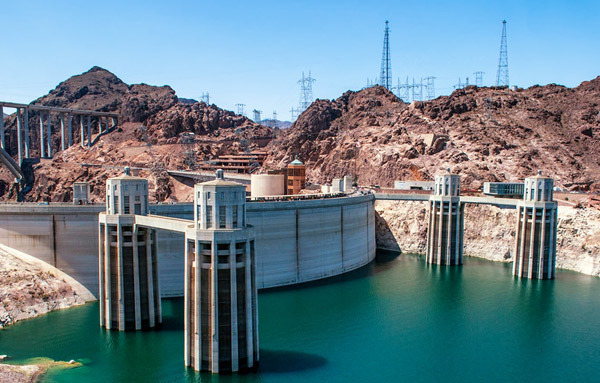
Hoover Dam and the Lake Mead it creates are critical infrastructure responsible for water and electricity in the western United States, but in recent years, water levels and power generation have been continuously declining.
As of mid-2025, the water level of Lake Mead is about 50 meters lower than the normal full pool level, maintaining only about 38% of its total capacity. The full pool level is set at approximately 1,229 feet above sea level, while the current level is reported to be around 1,064 feet.
This is significantly lower than average and is the result of a combination of prolonged drought, population growth, and reduced flow of the Colorado River. As precipitation decreases in the western region, the flow of the Colorado River is not being maintained, while water usage for agriculture and urban areas is increasing, slowing the recovery of the reservoir.
Such low water levels not only pose a problem of water quantity but also directly affect the power generation capacity of Hoover Dam. Hoover Dam originally has a maximum hydroelectric capacity of about 2,080 megawatts (MW) when at full pool.
However, with the current low water levels, the pressure is reduced, leading to decreased efficiency, and the actual operational power generation has dropped to about 1,300 MW. Experts warn that if this condition persists, the generation capacity could fall below 1,000 MW.
In particular, if the water level drops below 950 feet above sea level, it will reach a 'Dead Pool' state, making power generation completely impossible. If power production stops, it could disrupt electricity supply to major western states such as Nevada, Arizona, and California, making it a significant issue.
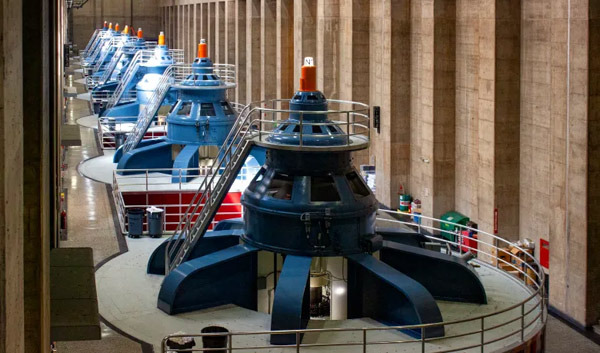
Currently, the electricity produced by Hoover Dam is evenly distributed among the three states, but the southern California region is the most dependent. Hoover Dam generates an average of about 4 billion kilowatt-hours (kWh) of electricity annually, but production has decreased by more than 10% in the last 1-2 years.
This is not only due to reduced hydropower but also the aging of generators and increased maintenance costs. Most of Hoover Dam's hydro turbines were replaced in the 1980s and 1990s, and now they are at a point where partial upgrades are needed.
The water shortage issue is also serious. Lake Mead serves as a major water source for Nevada, Arizona, and California, with a significant portion of drinking and agricultural water for southern California supplied from here. However, the drop in water levels has increased tensions over water allocation agreements among the state governments.
If it becomes difficult to maintain the water allocation set by the Colorado River Compact, measures such as restrictions on agricultural water and urban water shortages could become a reality. In fact, limited water use policies are already in effect in some areas of Nevada and Arizona, and water conservation measures are being considered in southern California.
Nevertheless, there are hopeful aspects. The US government and state water agencies are conducting large-scale water management programs to restore Hoover Dam's water levels. In some areas, artificial reservoir replenishment projects and plans to improve hydro facility efficiency are being implemented, and long-term measures to address climate change are also being discussed. Additionally, some turbines at Hoover Dam are being newly modified to operate even at low water levels.
Currently, the water level of Lake Mead at Hoover Dam is about 38%, and the power generation capacity is at 60% of normal. This is not just a temporary decline but a result of prolonged water shortages and climate change in the western region. Hoover Dam remains a lifeline for the western United States, but moving forward, more efficient and sustainable water and energy management will be essential. The current crisis can be seen as both a warning and a signal for change for the future.





 candytip |
 Gold Bar |
 Pirate Ship Popcorn Maker |
 Montgomery Mom |
 Anjollinya Blog |
 neroyo |
 celion78 |
 Folding Instructions |
 Say IT Now |
 US Legal Consultation on Trials |
  laro90 |
  MEDBIO American Doctor Blog |
  SWAT TEAM BLK |
  DREAM BIG |
  frostbite |
  330 Forever My Love |
  El Dorado |
  dralix58 |
  Gorama Round |
  Skydiving |
  dreamport |
  Yellow Snowman |
  Toaster Pizza Magic Show |
  velvetnom |
  Anytime Journey |
  Mrs. Duluth |
  jaxter |
  Atlanta Mama |
  Baguette Blog |
  Tan Sol |