

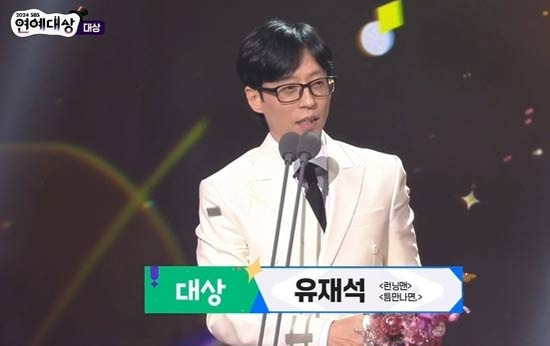
In the 2025 MBC Entertainment Awards, Yoo Jae-suk received the grand prize for his show "What Do You Do When You Play?" and at the 2025 SBS Entertainment Awards, he was awarded the title of 'SBS's Face Chosen by AI' for having the most broadcast time.
With this, Yoo Jae-suk set a remarkable record of 21 awards, including those from the three major broadcasting networks and the Baeksang Arts Awards, which is no longer surprising.
At this point, the same questions keep arising: "Is it Yoo Jae-suk again?" and "Aren't Korean viewers tired of him?"
Maintaining a top position in one field for over 20 years is rare in any country. However, from the perspective of consumers of popular culture, fatigue for change and a thirst for new faces naturally arise. Nevertheless, Korean society still places Yoo Jae-suk at the center. This phenomenon seems to be a result of not just individual popularity but also the structure of Korean media and public psychology.
The first reason is the scarcity of trust assets. As of 2026, the Korean media environment is structured around short-form content, real-time exposés, celebrity privacy controversies, and crime issues. Cases of a star's image collapsing overnight are repeated. In this structure, Yoo Jae-suk is almost the only case that has maintained a career for decades without any significant moral controversies. Viewers find stability in the programs he appears in, ensuring there is no risk. This is a stronger factor than popularity.
The second reason is his ability to evolve content. Yoo Jae-suk has not been fixed to a specific program image. Even after "Infinite Challenge," he has maintained his presence by moving across various formats such as variety shows, observational programs, talk shows, music, and web content. After joining Antenna, he expanded his activities to adapt to changes in the media environment, including TV, YouTube, and OTT, with younger audiences consuming him through short-form and clips rather than live broadcasts. This means he is not just a long-lasting star but a host who has adapted to changes in the media environment.
The third reason is his irreplaceability. The Korean broadcasting industry is structurally stability-oriented. Production companies rely on proven brands, and Yoo Jae-suk is the only person who has simultaneously proven his ability in ratings, advertising, and talent management. Although next-generation MC candidates have emerged, there is still no one who meets the criteria of public likability, hosting stability, privacy management, and industry trustworthiness at the same time. As a result, Yoo Jae-suk's dominance is a result of both personal ability and industry structure.
The fourth reason is the realm of records. Yoo Jae-suk's award wins are now closer to breaking records than competitive results. Viewers are more interested in how far he can go rather than who wins. The fact that one individual has maintained self-management and a career for decades becomes content in itself.
The reason Yoo Jae-suk continues to win awards in 2026 is not due to past glory but because of his ongoing competitiveness.
The fact that Korean viewers continue to choose him is a repeated choice of trust, the opposite of boredom. Yoo Jae-suk has become a genre beyond an individual, and it seems that his records will remain a difficult industrial benchmark to break for the time being.







 Egg Steamed Pot |
 novapixel |
 xylora |
 vegas mom |
 Coco and Lulu |
 Weekend Movie Blog |
 Beauty, Health, Lifestyle Blog |
 coloradoman |
 Superman Cat Blog |
 Victory 1988 |
  Korean Mom |
  My NYC |
  moo moo |
  Mr Oh |
  forevergee |
  festival |
  manchester |
  constant |
  Leapfrog Move |
  vibranto |
  Tora Tora |
  yellowbutter |
  Dolly |
  US Embassy |
  NYC saladbar |
  Finding Superfoods |
  lightyear |
  song bang |
  vexomo |
  Indiana Jones |