

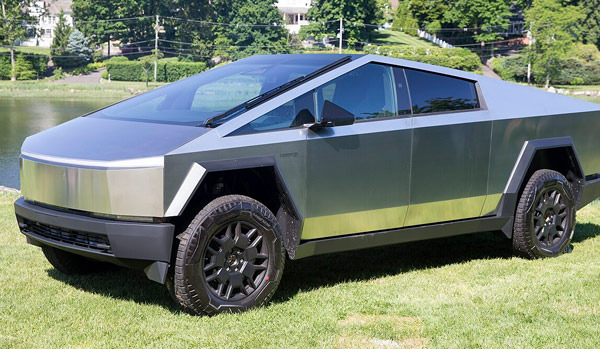
When I first encountered the Tesla Cybertruck driving on the freeway, the feeling I had was more of a sense of discomfort than surprise. I thought, 'Is this really something they are going to sell, it looks like a concept car?'
There is hardly any trace of the proportions or curves that a traditional pickup truck should have, and the wedge-shaped silhouette with sharp angles seems to have pulled a concept car from an 80s sci-fi movie into reality.
However, seeing this car not just as a concept but actually in production and naturally driving on public roads gradually changed my thoughts. Along with the realization that 'the baseline for pickup trucks has been pushed this far,' the question follows: 'Is this really a vehicle suitable for practical use?'
When evaluating the Cybertruck based solely on specifications, it is certainly not something to be taken lightly. The body uses ultra-hard 30X stainless steel alloy, making the panels themselves serve a structural role similar to a chassis. Unlike traditional bodies, it is not sensitive to paint quality or coating conditions, and due to the material properties, it is resistant to rust and corrosion, with very high surface strength.
In fact, its resistance to external impacts is definitely superior to that of existing aluminum or regular steel bodies, indicating that it was designed with the user's rough usage in mind. However, with such a bold reinforcement of the panels, how pedestrian safety and energy absorption structures are designed in the event of an accident will continue to be a topic of debate.
The driving performance is enough to make you forget that it is a 'pickup truck.' With the tri-motor AWD, the acceleration from 0 to 60 mph is around 3 seconds, or even in the 2-second range, which is a realm that should be compared to high-performance electric sports cars rather than traditional muscular V8 pickups. The range varies by trim, but the upper models can expect over 500 km in real-world driving, and the towing capacity is also announced to be around 10,000 pounds.
This means it has been elevated to a level where it can perform the inherent roles of a pickup, such as towing trailers for camping and transporting boats, rather than just being a toy-like experimental electric pickup.
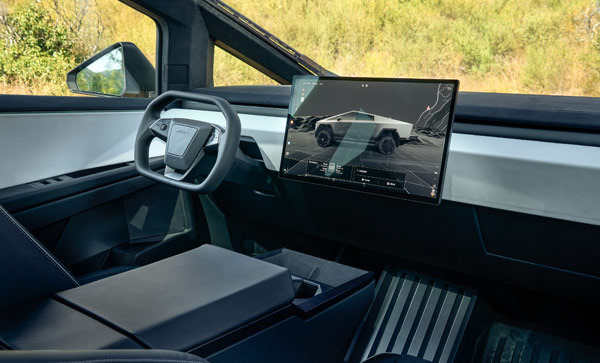
The advantages of the Cybertruck can be summarized in three main points.
First, the body structure emphasizes durability. The stainless steel panels are resistant to scratches and dents, and there is less stress regarding paint damage. This provides psychological comfort to owners who use it in harsh environments like off-roading or construction sites.
Second, the high torque and immediate acceleration unique to electric pickups. When loading cargo or towing a trailer, the initial pull is stable, and sufficient driving power can be secured even on hills and unpaved roads.
Third, the 'electronicization' based on OTA updates. Continuous improvements in driving assistance features, UI, and energy management logic through software updates mean that even after several years of ownership, there is less feeling that the performance has lagged behind that of used vehicles. This aspect is the most distinct difference from internal combustion engine pickups.
On the other hand, the disadvantages stem from discomfort in design and body finishing. The angular body and metal surface give a strong visual impression, but the intimidation it may cause to surrounding drivers in urban environments, the potential for glare in certain situations, and ongoing issues regarding pedestrian safety cannot be overlooked. While the stainless steel panels are sturdy, fingerprints, stains, and water spots are very visible, leading to evaluations that they require more maintenance in terms of washing and care. This is why there is a self-deprecating expression that describes it as 'a car you clean while driving.'
There are also common weaknesses of electric pickups. The curb weight is quite heavy, and due to battery characteristics, the range can drop significantly in long-distance towing situations. For users who enjoy the American pickup lifestyle, which involves driving hundreds of miles to go camping and freely utilizing charging infrastructure along the way, there are still practical limitations.
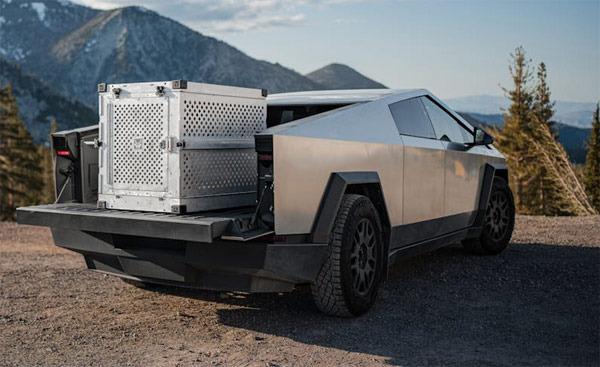
Even in areas with a well-established Supercharger network, how smooth the experience is when entering, parking, and charging at a charging station while towing a trailer is another issue. Insurance and repair costs are also likely to be significant burdens in future ownership costs. Given the unique material and structure of the panels, repairs after an accident will require different processes than standard body painting and metalwork, and there is a possibility that parts supply and labor costs will be high.
Nevertheless, it seems unlikely that the Cybertruck will end up being just a one-off event model. Looking at Tesla's track record, once a platform is included in the lineup, it has been consistently utilized through modifications and expansions. Just as they started with sedans and expanded to SUVs, compacts, and semi-trucks, there is ample possibility that the Cybertruck will also expand its family lineup to include Cyber SUVs and Cyber vans in the future.
The pickup market is a segment that holds significant symbolism in the United States, so if electric vehicles and software-centric approaches establish themselves to a certain extent in this area, the impact could be greater than expected. In summary, the Cybertruck is not just a matter of whether it is 'pretty or ugly,' but rather a litmus test of how far the automotive industry is ready to change its structure.
If traditional pickup trucks symbolize America's past and present, the Cybertruck can be seen as one of the candidates for the future of American mobility. While it is still too early to say whether this vehicle will achieve long-term success in the market, one thing is already clear: the Cybertruck has made a significant mark in automotive history as a model that intersects electric vehicles, pickup trucks, and automotive design itself.





 novapixel |
 Peter Pan Pet |
 horse |
 Sunset Oregon |
 daisypat |
 squidogame |
 Margarine Daebimama |
 eatontown blog |
 Living in New Jersey blog |
 Google Idea |
  vibranto |
  Tora Tora |
  yellowbutter |
  Dolly |
  US Embassy |
  NYC saladbar |
  Finding Superfoods |
  lightyear |
  song bang |
  vexomo |
  Indiana Jones |
  meloncat |
  mortrix |
  Esther 1983 |
  fortbliss |
  Moscow Kim |
  My Two Way |
  toastyfox |
  FLORIDA Acus |