

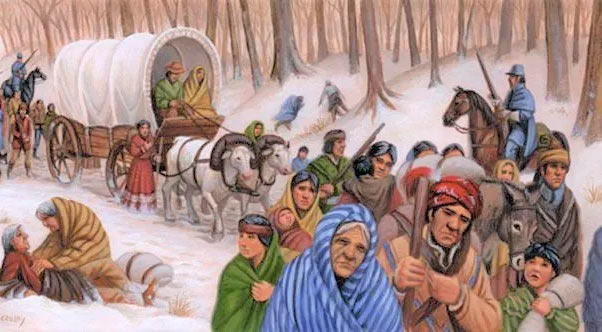
When Koreans think of the Westward Era, they often picture scenes from Western movies, such as sheriffs wearing cowboy hats, gunfights with villains, and heroes protecting towns. Images of endless deserts, horses kicking up dust, and slightly worn taverns in small towns come to mind. However, the actual history of the 'Westward Era' was not a romantic tale like those in movies, but rather a much more complex and harsh reality.
The Westward Expansion was not merely a period when people migrated to California; it refers to the mid-19th century when the United States expanded its territory from the East to the Pacific. The American Westward Expansion occurred from the mid-1800s to the early 1900s, during which Americans were moving westward.
During this time, people believed that the nation needed to expand to the Pacific, a belief known as 'Manifest Destiny.' However, in this process, the human rights of countless individuals were trampled. The most affected were the indigenous peoples who originally inhabited the land and the African Americans who were enslaved.
The greatest human rights violations occurred against the indigenous peoples. The U.S. government seized the land where the indigenous peoples lived and forcibly relocated them to other areas. The most famous incident was the 'Indian Removal Act (1830).' Because of this law, many indigenous peoples were forced to cross the Mississippi River to the far west, and many died from cold, starvation, and disease during the journey. This horrific journey is known as the 'Trail of Tears.'
Additionally, during this period, conflicts known as the Indian Wars continued to occur. White settlers sought to occupy indigenous lands, and while the indigenous peoples fought back, they mostly faced defeat. In some battles, entire indigenous villages were burned, and children and women were massacred. Thus, the culture and homelands of the indigenous peoples were completely destroyed. Their languages, religions, and ways of life disappeared, and they were forced to live in government-designated reservations.
Meanwhile, the Westward Expansion was also connected to the issue of slavery. At that time, in the South, African American slaves were working on farms, and as the country expanded westward, there was much debate over whether to allow slavery in the newly formed regions.
In areas like Texas, many African Americans continued to work as slaves. Some escaped in search of freedom and attempted to flee north through a secret route known as the 'Underground Railroad,' but many were caught while fleeing and faced severe punishment or death.
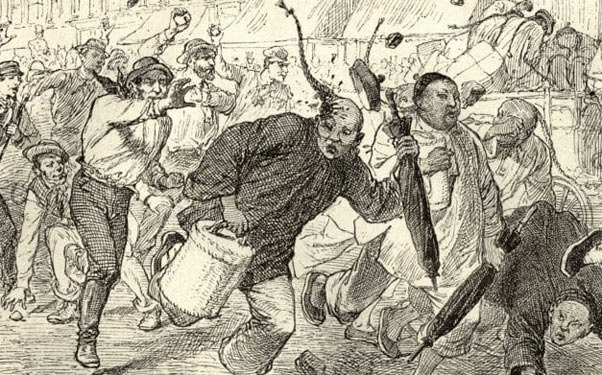
Moreover, during the process of laying down railroads to the West, Chinese immigrants played a crucial role but suffered severe discrimination and hardship. When the construction of the transcontinental railroad began in the 1860s, tens of thousands of Chinese were employed, mostly receiving low wages for dangerous work. The mountainous sections, particularly the blasting work in the Sierra Nevada, were handled by the Chinese. Many died or were injured in accidents while handling explosives, but they received no proper compensation.
They earned less than half of what white workers made for the same work and lived in poor accommodations. There were incidents where dozens were buried in snowstorms and landslides, but these were rarely reported in the newspapers. Even after the construction was completed, discrimination continued, as Chinese workers were excluded from white labor unions and were not allowed to own homes or businesses in towns. Ultimately, many Chinese laborers lost their lives in accidents during railroad construction, often without their names being recorded.
In the end, the Westward Expansion era was a time of great suffering hidden behind the name 'expansion.' Indigenous peoples lost their land, African Americans lost their freedom, and Chinese immigrants faced discrimination.
As we view the beautiful cities and cultures of the West today, we must not forget the history of those who sacrificed in this way.
The Westward Expansion era was not just a story of territorial expansion but a historical lesson on why human rights and equality are important.







 Weekend Movie Blog |
 Beauty, Health, Lifestyle Blog |
 coloradoman |
 Superman Cat Blog |
 novapixel |
  DREAM BIG |
  frostbite |
  330 Forever My Love |
  El Dorado |
  dralix58 |
  Gorama Round |
  Skydiving |
  dreamport |
  Yellow Snowman |
  Toaster Pizza Magic Show |
  velvetnom |
  Anytime Journey |
  Mrs. Duluth |
  jaxter |
  Atlanta Mama |
  Baguette Blog |
  Tan Sol |
  US Embassy |
  Korean Mom |
  My NYC |