
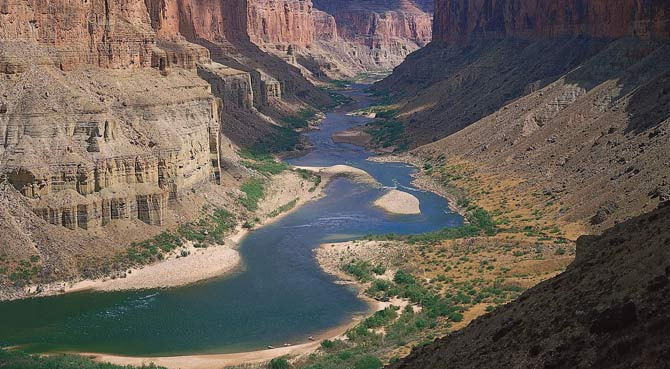
Living in Colorado makes you realize the value of water in everyday life.
Especially in the West, where rain is scarce, a single river often drives cities, farms, electricity, and daily life. The river at the center of it all is the Colorado River. On a map, it may just look like a long stream of water, but in reality, this river is a lifeline not only for Colorado but for the entire American West.
The Colorado River begins with melted snow from the Rocky Mountains and flows thousands of kilometers, crossing state lines, but its first stream is born right here in Colorado. In other words, the snow we see on mountain peaks during our walks and the heavy snowfall in winter become rivers in spring, and that river supplies life to people, cities, farms, and power plants. Without this river, the major cities of the West would not be as vibrant as they are today.
If Las Vegas is a miracle built on sand, the background of that miracle is ultimately the water of the Colorado River. Lake Mead, created by blocking the river with the Hoover Dam, supplies power and water, allowing city lights to shine in the middle of the desert.
Within Colorado, this river holds more meaning than just a scenic view. Especially in western Colorado, agriculture heavily relies on irrigation water connected to this river. Places like alfalfa, corn, orchards, and pastures would be nearly impossible to maintain without water. Due to the dry climate, relying solely on rain for farming is utterly insufficient, and only by drawing from the river can the fields come to life.
When water flows, the meadows turn green, but when the water stops, they quickly turn yellow, a scene easily witnessed in Colorado. Therefore, farmers are always attentive to the river's water levels, the speed of snowmelt, and dam release rates, and their farming plans can change based on river management plans. When there is plenty of water, the grass grows, and the cattle are healthy, but when drought strikes, the pastures dry up, and feed prices rise, which can disrupt the entire farm operation.
What would happen if the Colorado River stopped flowing?
Just thinking about it is frightening. First, agriculture would take a significant hit, and cracks could form in the entire water supply network of the West.
If the irrigation system is not secured, a significant portion of farmland would revert to desert in no time. As water decreases, power production also drops, reducing the efficiency of major power facilities like Hoover Dam and Glen Canyon Dam, which affects not just water issues but also power, economy, and urban life as a whole.
It's a domino effect that shakes not only Colorado but also Arizona, Nevada, and California. In fact, the reason the entire West has been on edge every time the phrase "Colorado River crisis" has emerged in recent years is precisely this.
However, it's not all a sad story. The people of Colorado understand the value of this river better than anyone. Water conservation campaigns, the development of efficient irrigation systems, and increased awareness of urban water savings are on the rise, and efforts to sustainably maintain the river are ongoing through state-level agreements.
Ultimately, the Colorado River is like the heart of Colorado. When water flows, cities breathe, fields come to life, electricity is generated, and people live their days on its banks. To travelers, it is a beautiful river that carves stunning canyons, but to residents, it is a practical resource that sustains their livelihoods.






 Your Curiosity Resolved |
 LIZ Legal Information Blog |

 coloradoman |
 Jean Claude Bundang Blog |
  DREAM BIG |
  frostbite |
  330 Forever My Love |
  El Dorado |
  dralix58 |
  Gorama Round |
  Skydiving |
  dreamport |
  Yellow Snowman |
  Toaster Pizza Magic Show |
  velvetnom |
  Anytime Journey |
  Mrs. Duluth |
  jaxter |
  Atlanta Mama |
  Baguette Blog |
  Tan Sol |
  US Embassy |
  Korean Mom |
  My NYC |