
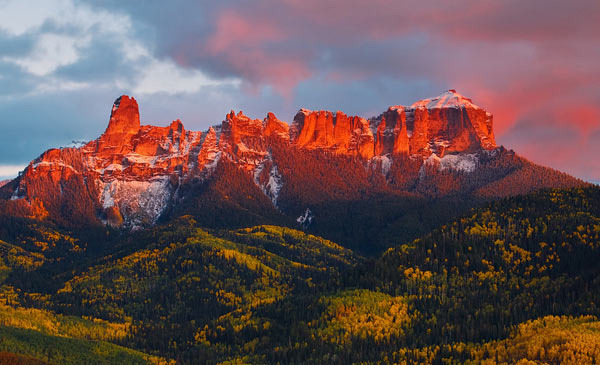
In a quiet plateau in southwestern Colorado, there is a unique rock formation known as Chimney Rock.
As the name suggests, this place features two massive rock pillars that rise like chimneys, and it is known not just as a natural sculpture but as a sacred site deeply connected to ancient civilizations. It is located near Pagosa Springs, in an area where the Ancestral Puebloans lived about 1,000 years ago.
They belonged to a cultural sphere connected to Chaco Canyon in present-day New Mexico, and Chimney Rock is said to have served as their astronomical and religious center. In fact, the main structures here are arranged to align with the lunar cycles.
Especially during the 'Major Lunar Standstill' phenomenon that occurs every 18.6 years, the sight of the moon passing precisely between the two rocks was considered a divine revelation by the ancients.
For this reason, it is also nicknamed the 'Temple Touching the Sky.'
Even today, astronomers and archaeologists periodically visit to observe this phenomenon, and the sight of the two rocks illuminated by moonlight under the night sky is nothing short of mystical. The Chimney Rock area has over 200 archaeological sites remaining.
The stone dwellings and ceremonial structures known as 'Kivas' created by the people of that time are also preserved. The stone walls and circular structures bear the marks of time, yet one can still feel traces of their lives and beliefs. The exploration course of the ruins is not long, but due to the altitude of over 2,000 meters and steep hills, there are quite a few ascents.
However, once you reach the summit, an expansive view unfolds. Red rocks and green plains stretch out, and distant mountain ranges extend like a horizon. Standing there, one immediately understands why the ancients considered this place sacred. It is not just a geological site but a symbolic place where the sky, humanity, and the flow of time intersect.
By participating in a local guided tour, you can also hear stories explained by archaeologists. The Ancestral Puebloans did not simply use this area as a residence but as a 'path of rituals' connected to the central hub of Chaco Canyon. In fact, the orientation of the main buildings at Chimney Rock is known to align precisely with the major structures of Chaco.
This is not mere coincidence but is evaluated as evidence that they possessed advanced astronomical knowledge capable of precisely calculating the movements of the moon and stars. Today, Chimney Rock is designated as a national monument and attracts thousands of tourists and researchers each year.
In spring and autumn, moonlight tours and star observation programs are also held, providing a special experience of viewing the Milky Way through telescopes. The harmony of the red rocks at sunset and the distant disappearing sun is overwhelming, making it hard to capture in photographs.
If you have the chance, it would be nice to visit. Personally, I found it to be a meaningful trip, inspired similarly to Santa Fe in New Mexico.








 Your Curiosity Resolved |

 coloradoman |
 Jean Claude Bundang Blog |
 Nuchuhan Exploration BLOG |
  Korean Mom |
  My NYC |
  moo moo |
  Mr Oh |
  forevergee |
  festival |
  manchester |
  constant |
  Leapfrog Move |
  vibranto |
  Tora Tora |
  yellowbutter |
  Dolly |
  US Embassy |
  NYC saladbar |
  Finding Superfoods |
  lightyear |
  song bang |
  vexomo |
  Indiana Jones |