

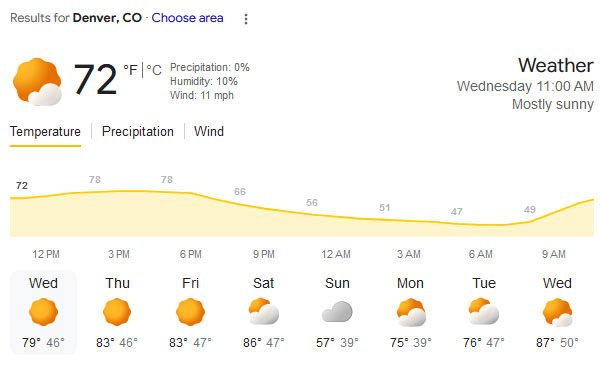
To sum up the weather in Denver, it truly fits the expression "Extreme Temperature Fluctuations" these days.
It feels like the seasons change two or three times within a single day.
During the day, it feels hot like summer, but as soon as the sun sets, the air feels like early autumn, or even early winter at times.
This isn't just a feeling; the actual numbers show quite an extreme range as well.
On Wednesday, it will be clear with a high of 79 degrees and a low of 46 degrees.
During the day, short sleeves feel natural, but in the morning and at night, it definitely gets chilly without a light jacket.
Thursday and Friday will see temperatures rise even more, reaching up to 83 degrees. Based on daytime temperatures, it almost feels like early summer.
However, the low temperature still hovers in the mid-40s. This means there's nearly a 35-degree difference within a single day.
On Saturday, temperatures will climb to 86 degrees. At this point, you might feel the urge to turn on the air conditioning during the day.
But at night, it drops back down to 47 degrees. It's not uncommon to sweat during the day and then turn on the heater at night.
This pattern makes clothing choices extremely important. Layering lightly is practically a survival strategy.
And then there's Sunday, which is problematic. Suddenly, the high temperature drops to 57 degrees.
It was in the mid-80s just the day before, but it drops nearly 30 degrees in just one day.
It feels like you've instantly transported to a completely different city. Plus, the low temperature is 39 degrees.
At night, it can feel almost like the beginning of winter. This is when many people end up catching colds.
The saying "I got sick because of the weather in Denver" didn't come from nowhere.
The reason for Denver's weather can be summed up in three words: "high, dry, and next to the mountains."Denver is located at an elevation of over a mile high, so the air density is significantly thinner compared to coastal cities like Los Angeles or New York.
During the day, the sunlight hits directly, causing it to warm up quickly, and at night, that heat escapes rapidly, leading to a sharp drop in temperature.
With low humidity, there's no buffer to hold the temperature steady. So, you experience both summer and autumn in the same day.
When you add the Rocky Mountains into the mix, the situation becomes even more dramatic. Air coming from the west compresses as it descends the mountains, creating a phenomenon known as 'downslope winds' that rapidly warms the air.
This is the famous Chinook wind. When the warmed air descends toward Denver, temperatures can suddenly spike.
Conversely, when cold air comes down from the north or Canada, the story changes completely.
The eastern plains of the Rockies have almost no geographical barriers, allowing cold air to slide down easily.
This cold air continues south through Colorado and all the way to Texas.
Ultimately, the weather in this region is a constant battle between "warm air descending from the mountains" and "cold air pushing down from the north."
Denver and Texas, situated in between, are affected by this every year. Therefore, this temperature fluctuation is not a coincidence; it's a nearly fixed event created by the geography.
Managing your health becomes important. When temperature fluctuations are severe, it can be hard for your body to adapt.Many people find themselves feeling unwell after dressing lightly during the warm day and then experiencing a drop in temperature at night. Staying hydrated is also crucial. The dry air causes your body to lose moisture faster than you might expect.
Interestingly, this kind of weather isn't all bad. Days are often great for outdoor activities with clear skies. Nights are cool, making for good sleeping conditions.
In conclusion, the current weather in Denver goes beyond just being unpredictable; the patterns themselves are extreme.
It feels like the seasons change within a single day.
So, in Denver, the question isn't "Is the weather nice today?" but rather "How many layers should I wear today?" which seems to be a daily concern for families.





 Study Abroad Life Know-How Tips |
 USA Business News |
 Hawaiian Soft Tofu HASOON |
 Shintongbangtong Shin Naerin James Park |
 California Dreamer |
 Golf Club News and Information |
 COLO COLO |
 Your Curiosity Resolved |

 Jellia Angel |
  My Town My Way Blog |
  Hawaiian Dooly Mom |
  Roman Pan |
  Key spots |
  Community Cross |
  Oz's Wow Company |
  Wenda |
  Nuchuhan Exploration BLOG |
  Who's watching? |
  Strawberry Pancake Warrior |
  What can make money? |
  Egg Steamed Pot |
  New Jersey News Local Stories |
  My Love DS |
  Leapfrog Move |
  US Regional Information Local News |
  Finding Superfoods |