

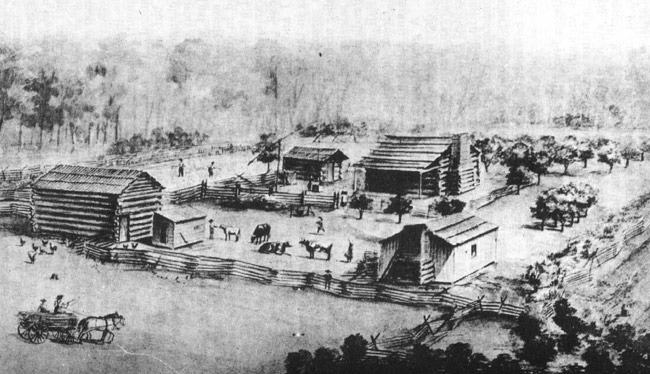
In the early 19th century, Indiana was not referred to as the "Midwest" as it is today.
At that time, people viewed this place as a complete "frontier." When we think of the West today, we picture areas like California or Colorado, but back then, crossing the Ohio River was already considered entering unknown territory.
Thus, New Englanders referred to places like Indiana, Ohio, and Illinois collectively as the "Western Frontier," and the phrase 'going West' meant 'heading to Indiana.' In the early 1800s, Indiana was still a land heavily populated by Native Americans.
It was one of the last areas to be settled east of the Mississippi River, and at that time, tribes such as the Shawnee, Miami, and Delaware lived along the rivers in communities. Their lives, hunting deer, bison, and turkeys, and cultivating corn, beans, and squash, were significantly disrupted by the expansion of European settlers.
The immigrants who crossed the Appalachian Mountains were mostly from New England states like Massachusetts, Connecticut, and Vermont. They loaded their belongings onto wagons as families and settled along the forests and rivers of Indiana after a long journey. They brought their church culture, educational systems, and town structures, creating the early society of Indiana.
As a result, traces of New England culture remain in the old churches, schools, and town names of Indiana today. However, the spread of settlers led to conflicts with Native Americans. Pioneers encroached on Native lands to secure hunting grounds and farmland, leading to numerous disputes.
In particular, the 'Battle of Tippecanoe' in 1811 is recorded as a significant event in Indiana's history. At that time, U.S. forces clashed with a Native American coalition led by Shawnee chief Tecumseh's brother Tenskwatawa, and this battle ultimately ended in a victory for the U.S. forces, greatly weakening Native American power in the Indiana region.
Afterward, Indiana was rapidly occupied by European settlers, and agricultural and livestock-centered settlements increased. Life for the early settlers was not easy. Most lived in log cabins and had to hunt or grow their own food. Their staple diet consisted of simple foods like venison, rabbit, turkey, cornbread, potatoes, apple jam, and maple syrup.
In an era without refrigeration, food was preserved through smoking or salting during the winter, and the entire family participated in farming and hunting. Indiana was officially admitted as the 19th state of the United States in 1816 and developed rapidly due to its fertile soil and abundant water resources. As part of the Northwest Territory, Indiana was a symbolic region where the U.S. began its systematic westward expansion.
Today, Indiana is at the center of the Midwest, but in the early 19th century, it was clearly the 'starting point of the West' and the forefront of the pioneer era. The history created by those who forged a new life on Native lands, along with the traces of conflict and coexistence that followed, can be seen as the foundation of today's Indiana culture.




 bada2002 |
 Now or Never |
 Yellow Snowman |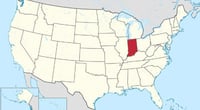
 Indiana Jones |
  Tonky |
  viroma |
  cookie |
  Live and that's it |
  Alright Twain |
  eatontown blog |
  HAWAII Korean Church News |
  Amore |
  linex |
  Balancework |
  laro90 |
  MEDBIO American Doctor Blog |
  SWAT TEAM BLK |
  DREAM BIG |
  frostbite |
  330 Forever My Love |
  El Dorado |
  dralix58 |
  Gorama Round |
  Skydiving |