


The history of the origin of coffee and its early consumption in Ethiopia is quite fascinating. From around 500 to 1000 AD, there are records that coffee was not only enjoyed as a beverage but also utilized in various ways. Initially, coffee beans were ground and roasted, then consumed by spreading them on bread, and there are also cases where they were mixed with animal fat and used as preserved food, adapted to the nomadic lifestyle.
By the 9th to 10th centuries, records of coffee cherries appeared in the Arab and Persian regions, but at that time, the method of grinding coffee to make a beverage was not yet common, so it was primarily recognized as a medicinal substance. In Europe, coffee was sometimes considered food of heretics, but the first region to eat and drink coffee cherries was the Ethiopian highlands.
In Ethiopia, there are legendary stories related to the discovery and consumption of coffee. One such tale is about a young shepherd named 'Kaldi,' who discovered the invigorating effects of the fruit after observing his goats becoming lively after eating it. When Kaldi informed the nearby Ethiopian Orthodox monastery, the monks initially misunderstood the fruit as belonging to the devil and threw it into the fire. However, captivated by the unique aroma that spread from the fire, the monks eventually roasted the fruit and began to drink it.
One of the main varieties of coffee we enjoy today, Arabica, originates from coffee trees that grow in the Ethiopian highlands and is highly regarded for its flavor and aroma. However, Arabica is susceptible to pests, which has made its cultivation challenging, partly due to the slow improvement of varieties compared to other grains or fruits.
Thus, the journey of coffee that began in Ethiopia shows that it has been utilized in various ways beyond just a beverage, as food, preserved food, and medicine. This historical and cultural background greatly helps us understand the rich flavors and tastes we experience when drinking coffee today.
Global Coffee Production
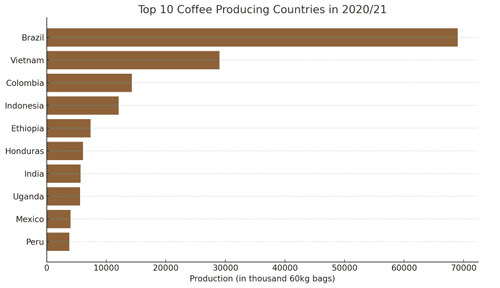
The top three representative countries are as follows.
Brazil
Brazil has maintained an absolute first place in global coffee production for a long time. Based on its vast territory and diverse climate conditions, it cultivates a wide range of coffee, from high-quality Arabica to mass-produced Robusta. The production volume of Brazilian coffee significantly influences the global coffee bean market prices depending on the year's harvest, and its scale and influence can be considered a benchmark for the coffee market.
Vietnam
Vietnam has established itself as the second-largest coffee producer in the world after Brazil, primarily focusing on mass production of Robusta coffee. With strong production capacity and an efficient cultivation system, Vietnamese coffee serves as an important supplier in the global market and has shown continuous growth in recent years.
Colombia
Colombia has maintained a long-standing reputation among global consumers for producing high-quality Arabica coffee. Thanks to its high altitude and optimal climate conditions, Colombian coffee is famous for its rich flavor and smooth taste, holding an important position in the premium coffee market. Colombian coffee is cultivated and harvested using traditional methods, boasting high standards in quality control.
Thus, Brazil, Vietnam, and Colombia each have unique strengths in terms of production volume and quality, making them key countries that significantly influence the global coffee market. Remembering that a cup of coffee enjoyed by consumers is backed by the rich agricultural techniques, climate, and cultural backgrounds of these countries will make each cup feel even more special.







 Baguette Blog |
 Khan Film Blog Production |
 dermoon |
 hoosierdaddy |
 sun walker |
 Illinois Mom |
 Rice Shop Uncle BLOG |
 Enjoyable American Life Diary |
 allstar realty |
  DREAM BIG |
  frostbite |
  330 Forever My Love |
  El Dorado |
  dralix58 |
  Gorama Round |
  Skydiving |
  dreamport |
  Yellow Snowman |
  Toaster Pizza Magic Show |
  velvetnom |
  Anytime Journey |
  Mrs. Duluth |
  jaxter |
  Atlanta Mama |
  Tan Sol |
  US Embassy |
  Korean Mom |
  My NYC |