

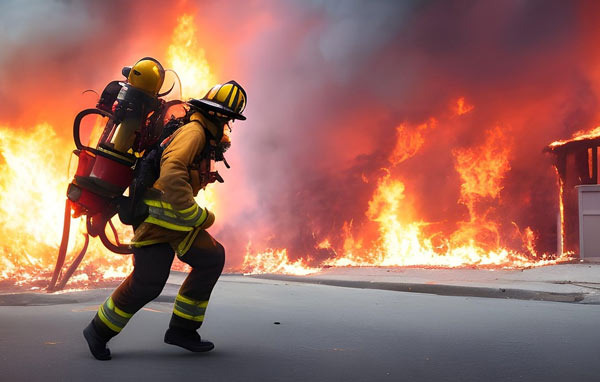
Working as a firefighter in Chicago is considered a "good job" in the U.S.
However, the reality is not as easy or straightforward as it seems.
From my friends working in finance in New York, I can see that firefighters face a similar structure.
On the surface, it looks stable and appealing, but there are calculations to be made underneath.
First, looking at the salary, Chicago firefighters start at around $74,000 as a base salary.
However, as they gain experience, the income structure changes.
Generally, the average salary for Chicago firefighters can rise to about $120,000.
Here's an important point.
It's not just the "base salary" but the "total income." This is because firefighters often have a lot of overtime (OT).
Especially in EMS (Emergency Medical Services), there is mandatory OT due to staff shortages.
As a result, it's quite common for actual salaries to reach up to $150,000.
Now, regarding benefits, the key for public employees in the U.S. is benefits rather than salary.
The first is retirement.
Chicago firefighters contribute about 9% of their salary to retirement, which they receive after retiring.
This is actually the core difference compared to private sector jobs.
The second is injury/disability coverage.
If injured on the job, there is a structure that guarantees about 75% of their salary for life.
This level of coverage is almost nonexistent in regular jobs.
The third is basic benefits.
Health insurance, dental, vision insurance, paid leave, and sick leave are all included as standard.
Additionally, uniform allowances and equipment support are provided separately.
So, is there hazard pay?
This is a common misconception.
Unlike in Korea, there isn't a clear structure for "hazard pay."
Instead, it is divided as follows:
- Duty Availability Pay
- Specialty Pay
- Holiday Pay
These are included in the pay structure.
It's not given under the name "hazard pay," but rather, the risks and job intensity are included in the overall salary structure.
The work pattern is also quite unique. Typically, they work 24 hours and then have a day off.
So it feels like working one day and resting the next, but the workdays are quite intense.
Now, we should also look at the realistic downsides.
First, the competition is fiercer than expected.
Becoming a Chicago firefighter is not a job anyone can just walk into.
One must pass exams, physical tests, background checks, and interviews.
Second, there are political elements involved. The influence of local networks cannot be ignored in U.S. public service jobs.
Third, the risks are a real concern.
This is something that goes without saying. It includes accidents, fires, and active shooter situations.
Finally, here's how the application process works.
- Check the job postings from the City of Chicago
- Written exam (Civil Service Exam)
- Physical test (CPAT)
- Interview and background check
- Fire Academy training (about 5-6 months)
- Probationary period work
One must pass all these steps to become a full-fledged firefighter.
In summary, a Chicago firefighter can earn between $120,000 and $150,000, and with OT, it can go even higher.
However, the retirement, benefits, and stability are very good.
But for Koreans, it's quite difficult to enter, the risks are real, and the work intensity is not trivial.
Thus, this job is not just about the money; it's also about stability and a sense of mission.







 Mr. Largo |
 Victory 1988 |
 Infinite Style |
 novapixel |
 zephyrs |
 Khan Film Blog Production |
 Rice Shop Uncle BLOG |
 Electricity Field Certification Collector |
  Illinois Mom |
 Life in the US |
  breezem |
  Omelet Rice for Strength |
  Vermont Capt |
  waltz |
  Shoot Me |
  Michigan Enthusiast |
  festive |
  Supplemental Security Income (SSI) Information |
  Sams Market |
  ansdal |
  VVV 80 |
  BIODOCTOR NEWS |
  Gold Bar |
  Tamfa Fan |
  Jenny's Mom blog |
  Karina's Blog |
  Best Frozen Yogurt |
  Coding Elf |