
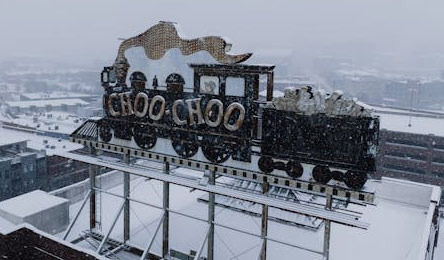
Chicago is a representative transportation hub in the Midwest of the United States, and railroads played a key role in the growth and development of this city.
The development of railroads, which began in the mid-19th century, transformed Chicago into a center of the national economy.
The Role of Railroads in Chicago's Growth
Chicago is strategically located to connect the East and West of the United States, establishing itself as a center of transportation and logistics from the beginning. The construction of railroads maximized this geographical advantage and accelerated the city's growth.
Starting in the 1850s, major railroad lines intersected in Chicago, allowing the city to grow as a major logistics center for grain, meat, and timber. Agricultural products and manufactured goods were distributed nationwide via railroads, and the meatpacking and manufacturing industries also developed rapidly.
With the completion of the transcontinental railroad in 1869, Chicago emerged as a key connection point between the East and West. This led to an increase in the number of people migrating to the city, resulting in greater economic prosperity.
Famous Train Stations
Union Station
- History: Union Station, opened in 1925, is Chicago's most representative train station and is considered a hub of railroad traffic in the United States.
- Features:
- Famous for its grand architectural style, the marble-decorated Great Hall is considered a landmark.
- It still serves as a major hub for Amtrak and Metra trains, handling millions of passengers each year.
- Significance: As the heart of the railroad system connecting Chicago and the rest of the United States, it remains an important transportation center.
LaSalle Street Station
- History: LaSalle Street Station, which first opened in 1852, was a historic train station that served as a major hub connecting Chicago and the Midwest.
- Features:
- Initially used as a terminus for various railroad companies, it was especially a major hub for the Rock Island Line.
- Today, it serves as a station for Metra commuter trains, with parts of the station integrated into modern urban design.
- Significance: A historic site symbolizing the history of railroads in Chicago and the development of transportation, it plays an important role in connecting the city's past and present.
Stations like Union Station and LaSalle Street Station remain symbolic places that encompass both the history and modern values of Chicago, going beyond mere transportation hubs. Reflecting on Chicago's railroad history is key to understanding how this city grew into the heart of America.








 Khan Film Blog Production |
 Illinois Mom |
 Rice Shop Uncle BLOG |
 allstar realty |
 Enjoyable American Life Diary |
  round1 |
  Way to easy |
  musicque |
  road98 |
  Churros Train Conductor |
  gleeful |
  Burbank Lee |
  Olivia's Blog |
  Bushing Around Life |
  Active |
  Cherokee Rose |
  Kor. Master |
  Holey Moley |
  Conflite Teacher |
  Hodong Prince Over Flex |
  Mist inn |
  citrus pop |
  Onion Ring |
  phoenixia |
  viewtop |