
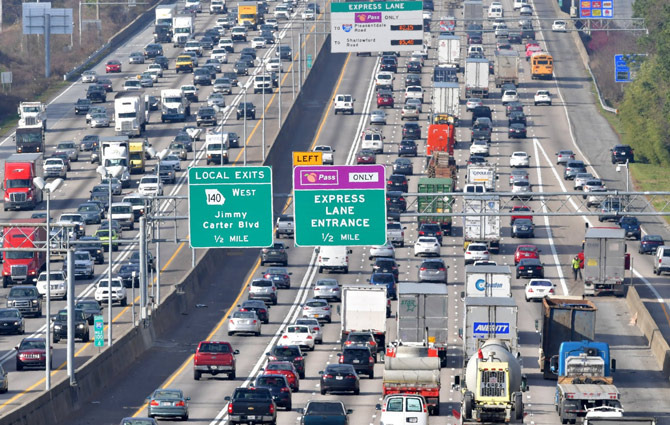
Everyone has probably sat stuck on freeways like I-85, I-75, I-285, or GA-400 at least once.
This city experiences traffic jams as a norm, and the saying 'an hour and a half commute is standard' is no joke. The state government introduced the 'Express Lane' to solve this issue.
Simply put, it is a toll lane where you can drive faster if you pay. Let's discuss whether this Express Lane truly helps alleviate traffic or if it is just a way to extract more money from citizens.
First, looking at the structure, Atlanta's Express Lanes are primarily installed on I-85 and I-75. Notably, there is the I-85 North Express Lane heading north towards downtown and the I-75 South Express Lane going south. Some sections of GA-400 are also included.
The usage method is simple. You attach an electronic tag called Peach Pass to your vehicle, and the designated fee is automatically charged. The fee varies based on demand. For example, during rush hours, the rate per mile can significantly increase, sometimes exceeding $10 to $15 on certain days. The question is whether this system effectively alleviates traffic congestion.
Theoretically, if more vehicles pay to use the Express Lane, the congestion in regular lanes should decrease, but many believe the actual effect is minimal. Especially among citizens who frequently use the I-85 section, there are complaints that "even when paying, the speed difference is not significant." In fact, some point out that the installation of lanes for the Express Lane has led to a reduction in existing regular lanes, causing even more congestion. Another complaint is about the issue of 'equity.'
For salaried workers commuting daily, paying $10 round trip adds up to over $200 a month. As a result, it has become a structure where only those with money benefit from time savings. Some sarcastically refer to it as "not an Express Lane, but an Elite Lane." The government claims that the revenue is reinvested into road improvements, but from the citizens' perspective, the perceived improvements are not significant, making it feel like a 'tax that isn't a tax.'
Another interesting point is that seeing the regular lanes stuck next to the Express Lane creates a psychological disconnect. When the same road allows those who pay to move freely while others are stuck, citizens' frustrations are bound to build up. Of course, some experts argue that "in the long run, there is a traffic distribution effect," but many drivers still do not feel that effect.
In conclusion, while the Express Lane in Atlanta is a decent 'idea,' the efficiency and fairness felt by citizens during its implementation are not satisfactory. Ultimately, the essence of the traffic problem lies not in buying lanes but in expanding public transport infrastructure and decentralizing urban areas.
If we continue to increase toll lanes on I-85 or I-75 as it is, it may lead to increased 'burden on citizens' rather than 'traffic relief.'







 Lululala |
 BOL SA RAM |
 Gook Rule |
 Blondee |
 Tonky |
  viroma |
  cookie |
  Live and that's it |
  Alright Twain |
  eatontown blog |
  HAWAII Korean Church News |
  Amore |
  linex |
  Balancework |
  laro90 |
  MEDBIO American Doctor Blog |
  SWAT TEAM BLK |
  DREAM BIG |
  frostbite |
  330 Forever My Love |
  El Dorado |
  dralix58 |
  Gorama Round |
  Skydiving |