

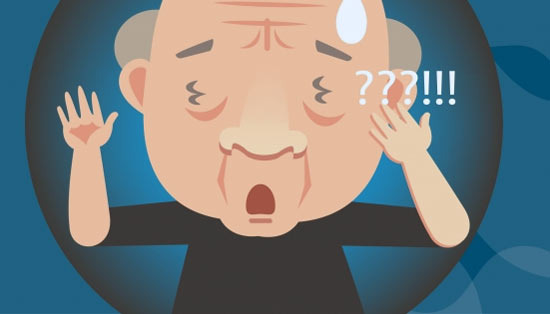
As a person approaches death, the energy of the entire body diminishes, leading to a general decline in function.
Among these, the eyes show significant changes. Common characteristics observed in hospital or home hospice settings include blurred vision, dulled brightness perception, and frequent loss of focus. Many report that familiar faces become hard to see or that their vision feels foggy.
This is a natural phenomenon that occurs as blood pressure drops, oxygen supply decreases, and brain function declines simultaneously. It can be seen as a gradual process where the ability to process visual information slowly fades as the body enters its final stage.
As this progresses, a phenomenon commonly referred to as the 'death stare' appears. The eyes may be open, but the person cannot focus on specific people or objects and instead stares blankly into space. Even when family members wave their hands asking, "Are you looking at me?" there may be no response.
At this time, the eyes may appear glassy, or the cornea may dry out and become red. As blood circulation weakens, the color of the pupils may become cloudy, and it is common for the pupils to hardly react even when light is shone on them. Externally, it may seem like the person is looking at something, but in reality, their visual recognition function is almost non-operational.
Many people experience hallucinations at this stage. They may report seeing deceased parents, spouses, siblings, or figures from long-ago memories, or they may point to the wall and express that someone is standing there. Medically, this is explained as a hallucination caused by a lack of oxygen in the brain and abnormal nerve transmission.
However, from the family's perspective, these scenes can often feel significant. Patients frequently display expressions of comfort or joy rather than fear. The words and expressions during this time are more likely to be responses emerging from a world mixed with memories and emotions rather than a reflection of reality.
Interestingly, while vision deteriorates quickly, hearing remains the last sense to fade among the five senses. Research and clinical experience show that even when a patient appears unresponsive, they can often still recognize the voices of those around them.
Therefore, medical staff encourage family members to continue speaking as usual, calling their names, and holding their hands. Phrases like "It's okay," "You've worked hard," and "We're here" can provide significant comfort during this time. Even as they depart from the world visually, they remain connected to it through their hearing.
The moment of death is not a time of coldness and distance but rather a time when the senses are gradually organized and quietly settled. Thus, the words and atmosphere of those nearby often become the last memories.
Understanding this process can help one face the moment of death with a somewhat less fearful and more peaceful mindset.





 neroyo |
 nivex85 |
 Old English |
 nixxon |
 LIZ Legal Information Blog |
 xylora |
 Aura-Infused WACAM |
 wendra |

 Dallas Fort Worth DFW |
  US Embassy |
  NYC saladbar |
  Finding Superfoods |
  lightyear |
  song bang |
  vexomo |
  Indiana Jones |
  meloncat |
  novapixel |
  mortrix |
  Esther 1983 |
  fortbliss |
  Moscow Kim |
  My Two Way |
  toastyfox |
  FLORIDA Acus |
  tracker |
  TONTON COFFEE |
  sunrise |
  ultron78 |