

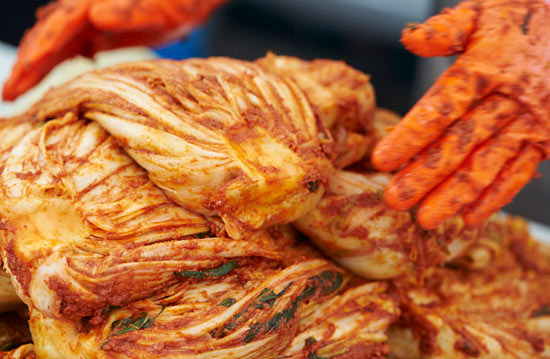
For those who have made kimchi, one common question is why we add a "paste" to the seasoning.
At first glance, one might think, "Why add something like porridge to kimchi?" However, this paste plays a quite important role.
First, the paste acts like an adhesive that helps the kimchi seasoning stick well. When mixing the kimchi, you can see how the seasoning clings to the cabbage. If you make the seasoning without the paste, ingredients like red pepper powder, garlic, and ginger do not mix well and easily slide off the cabbage. Adding the paste makes the seasoning slightly thicker, allowing it to adhere evenly between the cabbage leaves. One reason the seasoning penetrates well when eating kimchi is precisely because of this paste.
The second reason is that it aids fermentation. Kimchi is ultimately a fermented food. The unique refreshing taste that develops as kimchi ferments is due to the activity of lactic acid bacteria. However, lactic acid bacteria also need food. The paste added to kimchi is usually made from flour or sticky rice flour, and the starch contained within serves as food for the microorganisms during the fermentation process. In simple terms, the paste is like a little snack for the lactic acid bacteria in the kimchi. This helps the kimchi ferment more reliably.
The third reason is flavor balance. The paste softens the spiciness and saltiness of the kimchi. The seasoning made with red pepper powder and salted seafood can easily become overwhelmingly strong. By adding the paste, the overall texture becomes smoother, and the flavor rounds out a bit. As a result, the seasoning does not taste sharp when eating kimchi, but rather harmonious.
Another interesting point is that the type of paste varies slightly by region. Some households use flour paste, while others use sticky rice paste. Some people say that using sticky rice paste makes the seasoning stickier and allows for deeper fermentation. Conversely, in some regions, very little paste is added. The reason kimchi tastes different from house to house can stem from these small differences.
In the past, making kimchi paste was a small event. Water was boiled in a large pot, and flour or sticky rice flour was added and stirred until it thickened.
If the paste is too thin, it won't be effective, and if it's too thick, the seasoning becomes clumpy, so finding the right consistency requires some experience. Many people have memories of a pot of paste simmering in the kitchen of homes that made a lot of kimchi.
These days, the ingredients for kimchi seasoning have diversified, but many people still maintain the traditional method of adding paste. The reason is simple: adding paste helps the seasoning stick well, ensures stable fermentation, and softens the flavor. Although it may seem like a simple porridge-like ingredient, it can be considered a small secret that completes the flavor of kimchi.
Thus, when mixing kimchi seasoning, it becomes clear that kimchi is a dish completed by the combination of seemingly trivial elements.
Red pepper powder, garlic, salted seafood, cabbage, and the hidden paste in between. Considering that such small ingredients balance the flavor of kimchi, it feels like the long-standing kimchi culture is built on quite delicate wisdom.
 HawaiiTofu







 Kitchen Ideas |
 Yellow Snowman |
 Moscow Kim |
 Seattle - Emerald City |
 self-evaluation |
 Let's Be Like a Salt-like City Person |
 Dingho and USA News |
 Gimmi207 Blog |
 moonshine 7 |
 Gondola IT |
  The Gelaton |
  Twist Kim |
  berlon93 |
  Physical Laws and Science |
  good thinking |
  Solo Yolo |
  Mr Oh |
  laro90 |
  San Diego TOP Idol |
  Round and Round Children's Song Kingdom |
  American Golf Course Travelogue |
  MEDBIO American Doctor Blog |
  Hot Seat Driver |
  bryvexi |
  koala organic farm |
  riverstone |
  My Antonio |
  California Information News |
  chilli chilli |
  Moon Su San |