

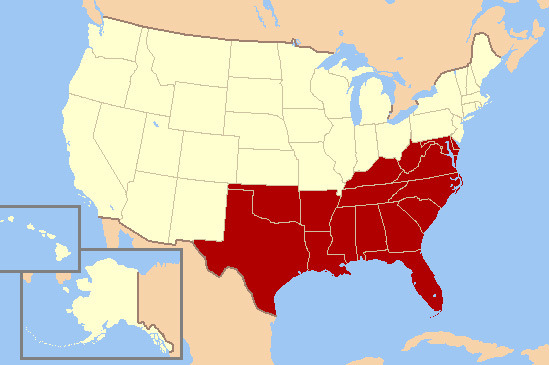
The Southern United States is one of the four major regions of the U.S. (Northeast, Midwest, South, West), characterized by a warm climate and unique history and culture.
However, people have slightly different perceptions of "how far does the South go?"
Generally, the following states are classified as Southern.
Southeast: Florida, Georgia, South Carolina, North Carolina, Virginia, etc.
Deep South: Louisiana, Mississippi, Alabama, parts of Georgia, parts of South Carolina, etc.
South Central: Includes Tennessee, Kentucky, Arkansas, southern Missouri, etc.
Southwest: Texas, Oklahoma, parts of New Mexico, etc.
According to the classification by the U.S. federal government (especially the Census Bureau), it is further subdivided. For example, it can be divided into 'South Atlantic', 'East South Central', 'West South Central'. However, in everyday terms, Texas, Louisiana, Mississippi, Alabama, Georgia, Florida, and Tennessee are often the first states that come to mind when thinking of the "Southern United States".
These regions generally have a hot and humid subtropical climate and have a special background as they were part of the 'Confederate States of America' during the Civil War. Additionally, the South is famous worldwide for its unique music (blues, country, jazz), cuisine (fried chicken, barbecue, Cajun/Creole dishes), and the warm hospitality culture known as "Southern Hospitality".
The Southern United States has played an important role in American history, not only due to its unique climate and culture. This region has witnessed significant events from the colonial era of Europe, through the Civil War, the Reconstruction era, to the Civil Rights Movement in the mid-20th century, symbolizing various changes and conflicts in American society. Today, we will briefly look at the history of the Southern United States.
In the early 17th century, European powers, including England, attempted to settle in North America, establishing Jamestown in present-day Virginia. From this time, the concept of the Southern United States began to take shape. The South was characterized by a warm climate and fertile land, leading to a rapidly established agricultural economy focused on crops like tobacco, rice, and cotton.
Along with this, slavery was introduced, leading to the development of a large-scale plantation culture in the South. Cotton and tobacco were mass-produced using the labor of enslaved African Americans, generating significant wealth through sales to the North and Europe. However, this also brought about a dark shadow of labor exploitation and human rights violations.
In the 19th century, conflicts between the North and South intensified over the federal government's authority and the issue of slavery. Ultimately, in 1861, 11 Southern states joined together to declare their secession from the United States, forming the Confederate States of America. The war waged by the North to preserve the Union was the Civil War. The war ended in 1865 with a Northern victory, and slavery was officially abolished, but the scars and economic collapse experienced by Southern society, as well as the conflicts between freed African Americans and whites, were not easily resolved.
After the war, the South underwent the Reconstruction Era, during which it attempted radical changes under direct federal control, such as creating new state constitutions and granting voting rights to Black men. However, as the Reconstruction Era came to an end, white supremacist groups regained control of local politics, and the Jim Crow laws they enacted institutionalized discrimination and segregation against Black people. As a result, Black individuals were legally forced into separation in schools, public transportation, and public places, making it difficult for them to exercise their voting rights.
In the mid-20th century, the Civil Rights Movement emerged in the South in response to this racial discrimination. Leaders like Martin Luther King Jr. led nonviolent protests demanding Black rights and equality, resulting in the enactment of the Civil Rights Act in 1964 and the Voting Rights Act in 1965, officially abolishing institutional discrimination. During this process, various Southern regions, such as Alabama, Mississippi, and Georgia, became sites of historical protests and conflicts.
After the Civil Rights Movement, the South began to diversify its economic structure through industrialization and urbanization. Instead of traditional agriculture, industries such as oil, automotive, aerospace, finance, and technology took root, and major cities (Atlanta, Dallas, Houston, etc.) grew rapidly. Despite these changes, the unique food, music (blues, jazz, country), and the warm hospitality culture of the South continue to maintain a distinct identity within the U.S.
Today, the South is a place where efforts to overcome past wounds and conflicts coexist with the desire to preserve its rich traditions. With a hot and humid climate, diverse food culture, and an economic structure that combines agriculture and high-tech industries, the South exudes a different charm compared to other regions in the U.S. Understanding the history of the South allows for a more nuanced view of the complex racial issues and political and social changes throughout the United States.
I hope you found this brief overview of the history of the Southern United States interesting.







 Khan Film Blog Production |
 dermoon |
 hoosierdaddy |
 sun walker |
 Let's Be Like a Salt-like City Person |
 Certified Authentication Blog Page |
 White bunny |
 melon90 |
 butter 90 |
 Jazz Queen |
  forevergee |
  festival |
  manchester |
  constant |
  Leapfrog Move |
  vibranto |
  Tora Tora |
  yellowbutter |
  Dolly |
  US Embassy |
  NYC saladbar |
  Finding Superfoods |
  lightyear |
  song bang |
  vexomo |
  Indiana Jones |
  meloncat |
  novapixel |
  mortrix |
  Esther 1983 |