
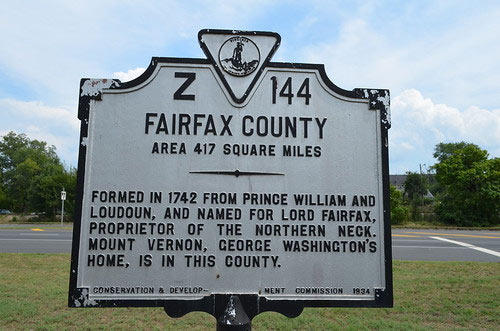
Fairfax may appear to be a suburban city with wide roads and neat housing developments, but the roots of this area actually trace back to early American history. At first glance, it seems like a modern development, but beneath the surface lies a long story that stretches from the colonial era through the Civil War to contemporary suburbanization.
The beginnings of this area date back to the Native American era. Before Europeans arrived, the Algonquin-speaking Doeg and Piscataway tribes settled along the Potomac River, living by hunting, fishing, and farming. They moved along the rivers and forests, and by the early 17th century, European explorers began to document their presence in this region. Then, in the mid-1600s, as British colonial expansion moved northward, this area began to transform into a settlement.
During this time, a key figure emerged who would give the area its name: the British noble Thomas Fairfax. He was granted vast lands in Northern Virginia, known as the 'Northern Neck,' by the crown, and due to this large land ownership, the entire area would later take on his name. In 1742, when it was separated from Prince William County, this new area was officially named 'Fairfax County.'
As time passed into the 18th and 19th centuries, the area established a plantation economy based on agriculture and slave labor. Tobacco and grain cultivation were particularly central, and the aristocratic families and large landowners held significant power. However, this area was not solely agricultural; it was also a place where the spirit of independence was stirring. The 'Fairfax Resolves,' drafted in 1774, was an important document that resisted British authority and asserted colonial rights, influencing the ideology of the independence movement. During the Civil War, this area became a strategic point for both the Union and Confederate armies, experiencing the scars of war firsthand.
After the mid-19th century, it gradually transformed from a rural village into a town. In 1805, a small crossroads village was named 'Town of Providence,' and in 1874, it was renamed 'Fairfax.' Then, in 1961, it was elevated to an independent city under Virginia law, becoming what we know today as the 'City of Fairfax.'
Today, Fairfax is no longer a small village centered around agriculture. It has developed into an economic, educational, and administrative hub right next to Washington D.C., hosting various industries and institutions, including government agencies, IT and defense companies, and universities. It is characterized by high education and income levels, where suburban comfort coexists with urban infrastructure.
In summary, the history of Fairfax is a story that spans from Native American land to British landownership, through the ideals of independence and the battlegrounds of war, leading to the modern suburban city we see today. This is the result of a new city continuously built upon that ancient history.






 Alpha and Omega World |
 Yellow Snowman |
 draxen |
 SODA MAKER |
  Tonky |
  viroma |
  cookie |
  Live and that's it |
  Alright Twain |
  eatontown blog |
  HAWAII Korean Church News |
  Amore |
  linex |
  Balancework |
  laro90 |
  MEDBIO American Doctor Blog |
  SWAT TEAM BLK |
  DREAM BIG |
  frostbite |
  330 Forever My Love |
  El Dorado |
  dralix58 |
  Gorama Round |
  Skydiving |