

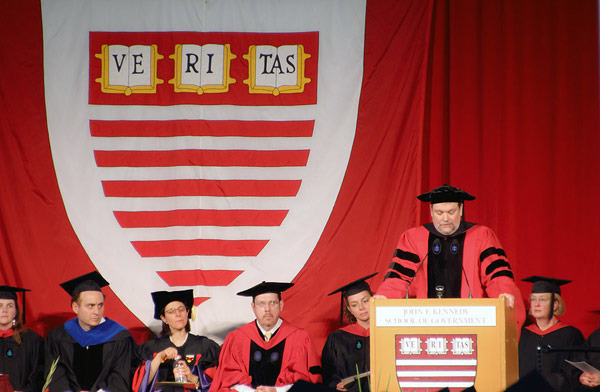
These days, there's a lot of talk about how even graduating from prestigious schools like Harvard doesn't guarantee a job that can cover tuition costs.
In the past, this would have been dismissed as an exaggeration, but now everyone seems to be nodding in agreement.
I believe this statement is half true and half false. However, the fact that such a question has arisen suggests that times have definitely changed.
Looking at Harvard's tuition, it's around $80,000 a year (including tuition, various fees, room, and board). Over four years, it easily exceeds $300,000. Many students receive scholarships or financial aid, but the middle class often finds themselves in a tricky position.
Due to parental income, support is lacking while the burden is heavy. I think that when students and parents from this class start to view it as an investment, they feel a pressing need to recoup that cost through post-graduation income.
The problem arises after graduation. There are still people who believe that just having a Harvard diploma automatically leads to a high salary.
But the reality is different. Except for a few who go directly into top positions in finance, consulting, or tech, starting salaries are often quite average. This is especially true for humanities and social sciences or academically focused majors. It's common to start with salaries in the range of $60,000 to $80,000. After taxes, it becomes difficult to even cover the principal of tuition, let alone the interest.
What's important here is that the question of whether Harvard generates income for its graduates is already an outdated way of thinking, in my view.
Today's market is much more focused on what you can actually do, what experiences you've gained, and what networks you've built, rather than just the school's brand. I believe Harvard offers many opportunities, but it does not guarantee results. The outcomes can vary drastically depending on how those opportunities are utilized.
Therefore, I think there are indeed people who graduate from Harvard and still can't recoup their tuition costs, especially those who entered believing only in the name of the prestigious school without a clear career path. Conversely, there are still individuals who create value far exceeding their tuition costs.
This phenomenon is not unique to Harvard. I believe it is a result of overall educational inflation.
As good diplomas are no longer rare, the market has become much harsher. A diploma is merely a ticket for entry, and after that, it's every person for themselves. Tuition is a fixed cost, while income has become a matter of probability, in my opinion.
Ultimately, this question returns to the essence of education. I think if you expect college to be a vocational training center, you're likely to be disappointed. If you view it as a space to expand your mindset and perspective, it still holds value. However, the moment you try to directly convert that value into money, the calculations become complicated.
So, I believe it is indeed true that we live in a world where even graduating from Harvard may not allow you to recoup your tuition costs.
At the same time, there are still people who can only take paths that are accessible through Harvard.
The issue lies not with the school, but with expectations. The moment you expect returns from the name of a prestigious school, reality often diverges from those expectations.
 SinbadInsure







 Magic Cabbage School of Martial Arts |
 Vacation on Hawaii |
 morvex37 |
 Ari Songhan American Immigration Life |
 Bearded Strawberry Smoothie |
 oh my salami |
 Komet Park |
 Victory 1988 |

 Finding Superfoods |
  lightyear |
  song bang |
  vexomo |
  Indiana Jones |
  meloncat |
  novapixel |
  mortrix |
  Esther 1983 |
  fortbliss |
  Moscow Kim |
  My Two Way |
  toastyfox |
  FLORIDA Acus |
  tracker |
  TONTON COFFEE |
  sunrise |
  ultron78 |
  uplifted |
  Folding Instructions |