

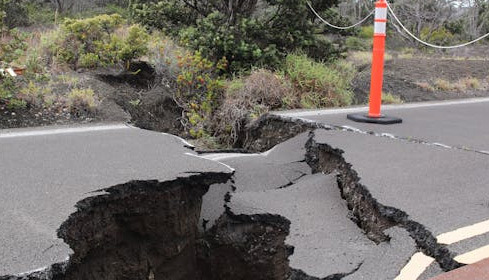
"Top 7 Areas in the U.S. with High Earthquake Risk"
The United States has a vast land area with various natural disaster risks in different regions. Earthquakes are commonly associated with the western coast due to regional characteristics, but surprisingly, some areas in the central and eastern parts also have significant risk levels.
1. Alaska
-
Characteristics
You might find it surprising that Alaska is ranked first in earthquake risk, but in fact, it is where the North American Plate and the Pacific Plate meet, resulting in very active fault lines. The strongest earthquake in U.S. history also occurred in Alaska. -
Notable Example
The 1964 Alaska Earthquake (Good Friday Earthquake) had a magnitude of 9.2, making it one of the strongest earthquakes in North American history. Since then, both large and small earthquakes have continued to be observed.
2. California
-
Characteristics
California is one of the first places that comes to mind when thinking of "earthquakes." With numerous fault lines, including the San Andreas Fault, the potential for large-scale earthquakes is always present. -
Notable Example
The 1906 San Francisco Earthquake caused massive destruction, leaving most of the city in ruins, and the 1989 Loma Prieta earthquake also had a significant impact on the San Francisco and Oakland areas.
3. Hawaii
-
Characteristics
Hawaii, with its active volcanic activity, also has a high risk of earthquakes. Earthquakes frequently occur during the movement of volcanic magma, and they are also indirectly affected by underwater tectonic plate activity. -
Notable Example
During the 2018 Kilauea volcanic eruption, significant earthquakes were detected multiple times, leading to evacuations of nearby residents.
4. Washington
-
Characteristics
The northwestern region of the U.S. is also prone to earthquakes due to its proximity to tectonic plate boundaries. The massive Cascadia Subduction Zone raises concerns about the possibility of large-scale earthquakes (known as 'megathrust earthquakes'). -
Notable Example
Historical records and geological studies suggest that a massive earthquake of around magnitude 9.0 occurred in the coastal areas of Washington and Oregon in 1700.
5. Oregon
-
Characteristics
Like Washington, Oregon is part of the Cascadia Subduction Zone, making it highly susceptible to earthquakes. Particularly, the section connecting the Pacific Ocean to the coast is a subduction zone, raising concerns about the potential for a massive earthquake known as the 'Big One' at any time. -
Notable Example
The entire coastline of Oregon is considered a risk area, with concerns about potential tsunami risks in the event of an earthquake.
6. Nevada
-
Characteristics
Nevada may seem unfamiliar when it comes to earthquakes, but due to the geological structure known as the 'Basin and Range,' fault activity occurs consistently. It is often affected by tectonic movements from eastern California. -
Notable Example
In central and western Nevada, both large and small earthquakes have been continuously observed, and significant earthquakes of magnitude 6 or higher are not uncommon.
7. New Madrid Seismic Zone
-
Characteristics
Located in the central region, the New Madrid Seismic Zone encompasses Missouri, Arkansas, Tennessee, and Kentucky. It is also the site of some of the strongest earthquakes in U.S. history that occurred in the early 1800s. -
Notable Example
The series of New Madrid Earthquakes between 1811 and 1812 was so powerful that it is said to have changed the course of the Mississippi River. If this seismic zone were to reactivate today, it could have tremendous repercussions.
We have explored the seven areas in the U.S. with high earthquake risk. These include primarily the Pacific coast, Alaska, Hawaii, and surprisingly, the central inland New Madrid Seismic Zone. The U.S. has a much larger tectonic boundary and complex crustal structure than the Korean Peninsula, making it almost devoid of earthquake-safe zones.
If you are planning to travel or relocate, it would be wise to check the seismic design of buildings and disaster preparedness manuals in those areas in advance.







 El Dorado |
 lightyear |
 Moscow Kim |
 coloradoman |
 Montgomery Mom |
 Toaster Pizza Magic Show |
 Baguette Blog |
 Total Beauty |
 Pirate Ship Popcorn Maker |
 ROLDU WAY |
  Tonky |
  viroma |
  cookie |
  Live and that's it |
  Alright Twain |
  eatontown blog |
  HAWAII Korean Church News |
  Amore |
  linex |
  Balancework |
  laro90 |
  MEDBIO American Doctor Blog |
  SWAT TEAM BLK |
  DREAM BIG |
  frostbite |
  330 Forever My Love |
  dralix58 |
  Gorama Round |
  Skydiving |