

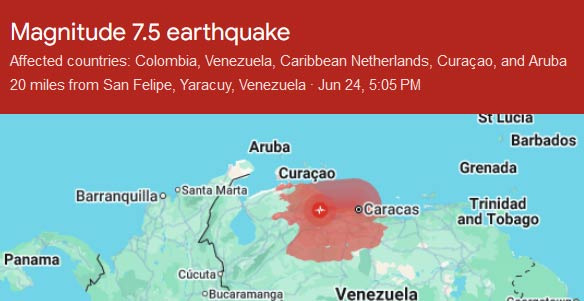
Previously, we heard about major earthquakes in countries like Chile and Haiti, and now it's Venezuela's turn.
With reports of strong earthquakes coming from South America and the Caribbean, I found myself wondering, "Why are such large earthquakes happening so frequently?"
Just watching the international news about the tremendous damage inflicted on people is enough to weigh heavily on the heart.
This earthquake in Venezuela is not just significant in magnitude. The United States Geological Survey (USGS) has rated it as the strongest earthquake to hit Venezuela since 1900. It is the largest earthquake in 126 years.
This earthquake unfolded in an instant, almost like a scene from a movie.A magnitude 7.2 earthquake struck just off the northern Caribbean coast of Venezuela, west of Morón. As many people rushed outside in shock, a more powerful magnitude 7.5 earthquake followed about 45 km from the first epicenter.
Buildings that were already shaking could not withstand the second shock and collapsed. The epicenter was about 160 km from the capital, Caracas, but the tremors were felt throughout Venezuela.
In particular, the damage in the capital Caracas and the northern coastal state of La Guaira was severe. Dozens of buildings collapsed, and local footage showed that coastal hotels were nearly completely destroyed, leaving only parts of their entrances intact. Airports, roads, hospitals, and power facilities were also damaged, significantly paralyzing urban functions.
As of now, the official death toll stands at 164, with 971 injured. However, as rescue operations continue, the number of casualties is likely to rise. There are even reports speculating that the death toll could exceed tens of thousands.
It is estimated that many people are still trapped inside the collapsed buildings, and firefighters, police, and military personnel have been mobilized for rescue operations. What is even more concerning is the aftershocks. The Venezuelan Geological Society has warned that aftershocks of magnitude 5 or higher could continue to occur.
There have already been over 20 aftershocks, and buildings that were damaged in the main quake are at risk of further collapse from even minor aftershocks. Therefore, rescue teams are proceeding cautiously, aware of the risk of additional collapses.
The international community, including the United States and several Latin American countries, has announced plans to send rescue teams, medical personnel, and emergency relief supplies. This scene once again demonstrates that disasters know no borders.
Reflecting on this earthquake, it is clear that a difference of just one number in magnitude over 7 is significant.
Since the earthquake scale is logarithmic, a magnitude 7.5 releases much more energy than a 7.2. Although the difference is only 0.3, the actual energy released is nearly three times greater. This analysis suggests that the second earthquake dramatically increased the damage.
In recent months, there have been reports of significant earthquakes around the world. Each time a major earthquake occurs, it reminds us of the importance of disaster preparedness, which we often forget in our daily lives. No matter how advanced technology becomes, we cannot prevent earthquakes.
Ultimately, the most realistic way to reduce damage is through strong buildings, thorough preparedness, and efficient rescue systems, as this earthquake in Venezuela has once again shown.
 ToilTomorrow







 California Dreamer |
 Sugar Cream Door Bulletproof Noodles |
 Investment Campus Home Ownership |
 U.S. Retirement Pension Information |

 Infinite Style |
 Koreab Date |
 US Home Buying Information Home Insurance |
 Grow Your Gut Bacteria Well |
 Only Dentalbay |
  novapixel |
  Idaho's Sumi's House |
  Mr. Midwest America |
  wildfire |
  legalway |
  postcard |
  cheesecake07 |
  My Miami Stories |
  windylotus |
  Mia Flori |
  velaro29 |
  velaro |
  foxtrot83 |
  moname |
  mapleline |
  US Legal Consultation on Trials |
  UNI Lover |
  Karina's Blog |
  Choco Mint Creator |