

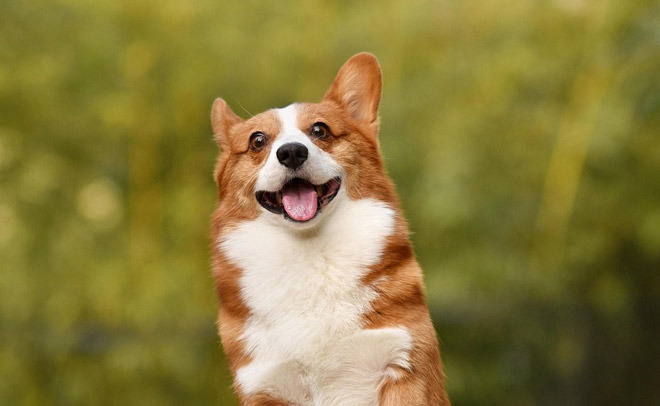
People who have raised dogs for a long time know this well.
That dog has a happy expression right now. That one looks sulky, and that one is definitely asking for a treat.
But have you ever wondered if dogs really make expressions or if that's just how we perceive them?
The interesting thing is that this is not just a simple illusion.
Research shows that dogs have a different facial muscle structure compared to wolves.
In particular, the muscles that lift the eyebrows are more developed.
Using these muscles makes the eyes appear rounder, which, from a human perspective, creates a "sad expression."
This is where the story gets a bit more interesting.
Wolves hardly use these muscles.
Even though they started from the same species, why do only dogs make these expressions? The reason is humans.
Thousands of years ago, humans began to choose relatively docile wolves to live with.
Among them, dogs that could make good eye contact, had positive reactions, and seemed to convey emotions survived longer.
And that trait was passed down.
In simple terms, dogs that could make a face saying "I'm nice" with big eyes got more food, lived longer, and reproduced more.
They evolved alongside humans.
In fact, similar results have been found in shelter studies.
Dogs that raised their eyebrows when looking at people were more likely to be adopted than those that did not. Expressions became a survival strategy.
Up to this point, it's a fact.
Now, from here on, it's a bit of speculation.
Perhaps dogs are the first animals to study humans.
They may have learned over generations what kind of faces make humans weak, what kind of gazes melt hearts.
While humans think they have tamed dogs, it's possible that dogs have tamed human emotions in return.
Especially 'that expression.' The face that looks up with its head slightly lowered when scolded.
It's hard to stay angry when you see that. Scientifically, when the eyes appear larger, it triggers a protective instinct in humans.
This is because it resembles the structure of a baby's face.
So, dogs are actually using this strategy.
"To survive, look cute."
This strategy has been perfectly successful for thousands of years.
Now they are family, take over the sofa, and even get on the bed.
In the end, we can summarize it like this.
The reason dogs have expressions is not only for emotional expression but also as a result of evolving to survive alongside humans.
The reason they became the closest animals to humans may not be strength, but the ability to touch emotions.
Perhaps dogs are both humanity's oldest friends and the most successful psychological strategists.
And today, that strategy is still working well. Just raise an eyebrow, and a treat comes out.







 novapixel |
 Peter Pan Pet |
 horse |
 Sunset Oregon |
 daisypat |
 American Food Information & Calories |
 What can make money? |

 OC Real Estate Business Information |
 Finding Superfoods |
  lightyear |
  song bang |
  vexomo |
  Indiana Jones |
  meloncat |
  mortrix |
  Esther 1983 |
  fortbliss |
  Moscow Kim |
  My Two Way |
  toastyfox |
  FLORIDA Acus |
  tracker |
  TONTON COFFEE |
  sunrise |
  ultron78 |
  uplifted |
  Folding Instructions |