


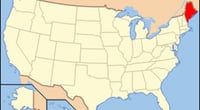
Augusta is the capital of the state of Maine and, although a small city, has played an important role in the history and culture of Maine. Today, I will briefly summarize the history and characteristics of Augusta.
The Augusta area was originally inhabited by the Algonquin tribe, the indigenous people. They lived along the Kennebec River, which served as a major transportation and trade route. Europeans arrived in the area in 1607 when English Popham colonists established a settlement near the Kennebec River. Initially, the fur trade along the river developed and laid the foundation for the local economy.
In 1754, the British built a fort (now Fort Western) west of the Kennebec River, which became the center of Augusta. Fort Western is the oldest wooden fort in the United States and functioned as an early military and commercial center in Maine. Later, in 1797, it began as part of the Hallowell area and was separated in 1799 under the name "Hallowell North". The city is said to be named in honor of Augusta Dearborn, the daughter of General Henry Dearborn, a hero of the American Revolutionary War, in 1799.
In 1820, when Maine was separated from Massachusetts and became an independent state, Augusta became an important administrative center. In 1832, Augusta was officially designated as the capital of Maine, and the Maine State House was built here. The state house was designed by the famous architect Charles Bulfinch and continues to serve as the center of Maine's politics and administration today.
From the mid-19th century, Augusta began to grow as a center of industry and commerce. The transportation of timber via the Kennebec River, along with gristmills and paper mills, drove the local economy, and a bustling trade network formed around the river. As the railroad network expanded, more people moved to Augusta, strengthening the city's economic base.
Today, Augusta has established itself as the center of politics and administration in Maine while maintaining the relaxed atmosphere characteristic of a small city. In addition to historical landmarks such as the state house and Fort Western, there are many cultural attractions like parks along the Kennebec River and museums.
Augusta is an important city that connects Maine's past and present, possessing a unique charm where history, culture, and nature blend together.






 fortbliss |
 Folding Instructions |
 yentra |
 Cali M Law Group |
 quanta7 |
 milkyotter |
 cookiefox |
 US Regional Information Blog |
 U.S. Weather Bureau News |
 Tora Tora |
  yellowbutter |
  Dolly |
  US Embassy |
  NYC saladbar |
  Finding Superfoods |
  lightyear |
  song bang |
  vexomo |
  Indiana Jones |
  meloncat |
  novapixel |
  mortrix |
  Esther 1983 |
  Moscow Kim |
  My Two Way |
  toastyfox |
  FLORIDA Acus |
  tracker |