
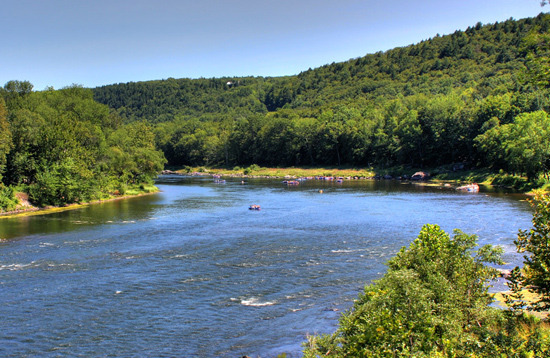
The name of Delaware state is said to be derived from the Delaware River.
Originally, this area was inhabited by the Lenape tribe, who called this river 'Lenapewihittuk', meaning 'the river of the Lenape'. The river was not just a waterway but their lifeline and a sacred space. However, over time, as European colonial powers arrived, the name, land, and culture changed significantly.
In the early 17th century, the river was named after Thomas West, 3rd Baron De La Warr, the Virginia governor who earned his name for defending the colony during the Anglo-Powhatan Wars.
The first Europeans to set foot in this area did so in 1609. Explorer Henry Hudson sailed into Delaware Bay for the Dutch East India Company, marking the first appearance of this area on European maps. After that, the Dutch and the English competed to claim the region, but the settlements did not last long.
In 1638, the Swedes, along with Finns, established a colony called 'New Sweden', permanently settling near present-day Wilmington at Port Christina. They built wooden forts and thrived through trade, but that peace did not last long.
In 1651, the Dutch established Fort Casimir in nearby Newcastle, and the New Sweden soldiers temporarily occupied it. However, the following year, angry Dutch forces retaliated, recapturing Casimir and ultimately conquering all of New Sweden. Thus, the Delaware region fell back into Dutch hands. But this was only temporary. In 1664, as war broke out between England and the Netherlands, the Delaware region was incorporated into the English New York colony, and in 1682, William Penn received the area from the Duke of York, making it part of the Pennsylvania colony.
The Delaware River was an important boundary and transportation hub even then. This river connecting Pennsylvania and Delaware developed into a commercial artery, and the Delaware region, known as the 'Southern Three Counties', gradually developed its own identity.
As Pennsylvania grew, Delaware residents began to voice their independence, and finally, in 1701, the 'Free Charter' was enacted, leading to a peaceful separation. In 1704, an independent assembly was established, but administrative power still remained with the Pennsylvania governor.
Then, in the fateful year of 1776, Delaware became one of the 13 states to sign the Declaration of Independence amidst the waves of the Revolutionary War.
Afterward, it agreed to the 'Articles of Confederation', forming the early union of states in America. Among them, Delaware was recorded as the first state to ratify the Constitution on December 7, 1787, earning the nickname "The First State".
Today, the Delaware River remains an iconic river in the eastern United States. The cities formed along the river have developed into centers of industry and trade, and the river's historic name continues to be a source of pride and historical roots for the people of this region.







 candytip |
 Gold Bar |
 Pirate Ship Popcorn Maker |
 Montgomery Mom |
 Anjollinya Blog |
 Doori Ark |


 Min's blog |

 Generation X |
  Korean Mom |
  My NYC |
  moo moo |
  Mr Oh |
  forevergee |
  festival |
  manchester |
  constant |
  Leapfrog Move |
  vibranto |
  Tora Tora |
  yellowbutter |
  Dolly |
  US Embassy |
  NYC saladbar |
  Finding Superfoods |
  lightyear |
  song bang |
  vexomo |
  Indiana Jones |