

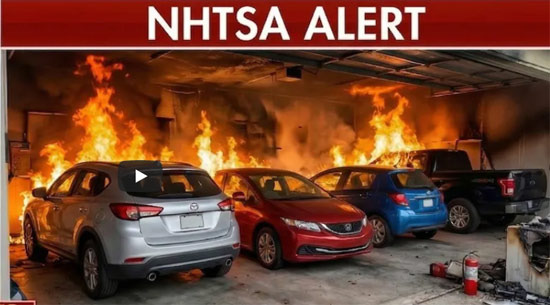
These days, the news says that it used to be "cars could catch fire in an accident," but now it's "cars can catch fire even when they are parked."
Currently, a recommendation has been issued not to park in garages for 1.1 million vehicles in the U.S.
This is because fires can suddenly occur even when the vehicle is parked due to battery defects or electrical shorts.
Especially in a garage, which is a confined space, if a fire starts, it can lead to problems that affect not just the vehicle but the entire house.
The federal regulatory agency has issued this recommendation for this very reason. Modern vehicles rely on high-voltage batteries and complex electrical systems, and if something goes wrong, a fire can occur even when no one is inside the vehicle.
What's even scarier is that most fires occur "without warning." They can happen even when the vehicle is not charging or in use, just while parked. That's why there's a warning against parking in garages.
Vehicles with parking restrictions (Active Alerts)
- Jeep Wrangler 4xe (Hybrid)
- Chevrolet Bolt EV
- Chrysler Pacifica (Hybrid)
- Some Hyundai & Kia models (sedans and SUVs subject to ABS module recalls)
- Some BMW models (issues related to engine management systems)
Reasons for parking restrictions
- Fire risk. There is a possibility of spontaneous combustion even when the vehicle is turned off.
- Safety concerns. The risk of a fire in a garage spreading to the home is very high.
- Over 1.1 million vehicles are affected, and some have reported risks even after repairs.
Checklist for vehicle owners
- Check your vehicle's VIN number to confirm if it is subject to a recall.
- It is recommended to check the latest recall status on the NHTSA official website.
Tesla also presents an interesting case. In some countries, there are movements to restrict parking high-charging electric vehicles in underground garages. This regulation came after actual fire incidents.
So, what should drivers do? The first step is to check if your vehicle is on the recall list.
In the U.S., you can check your VIN number directly on the NHTSA site. It's a good idea to do this. Many people think, "I should be fine," only to find out they are not.
The second step is to consider your parking habits. If your vehicle is on the list, it's safer to park it away from your home or building.
Especially, it's best to avoid parking in garages. The third step is to review your charging habits. If you have a plug-in hybrid or electric vehicle, you should reconsider the habit of charging overnight. This is especially true for vehicles with warnings.
Finally, if you receive a recall notice, you should get repairs done as soon as possible.
However, realistically, it may take time due to parts supply issues. More importantly, in some cases, problems have occurred even after recalls.
This means that vehicle maintenance is not just the manufacturer's responsibility. Drivers also need to stay vigilant.
As many know, a significant electric vehicle fire issue occurred in South Korea in 2024 at the Incheon Cheongna apartment, involving a Mercedes electric vehicle in an underground parking garage.The incident reportedly started with a parked Mercedes EQE electric vehicle in the underground garage, resulting in 87 vehicles being completely burned and a total of 783 vehicles suffering damage from soot and other issues. Another investigation even counted up to 959 affected vehicles.
There were also injuries. Over 20 residents were hospitalized for smoke inhalation, and an evacuation was necessary. The damage was so severe that it disrupted the entire functionality of the apartment due to damage to parking facilities, plumbing, and other infrastructure.
The impact of this incident went beyond just an accident. Some apartments have actually implemented measures to ban or restrict electric vehicles from underground parking. The term "electric vehicle phobia" has even emerged, affecting the market.
Nowadays, cars are no longer just "things to drive around in." As technology has advanced, the need for management and risk awareness has also increased. Especially with the shift towards electricity and batteries, the nature of risks has changed. We have entered an era where even parking in a garage requires careful consideration.






 Encyclopedia of New York and Surrounding Areas |
 washington mom |
 California Dreamer |
 Sugar Cream Door Bulletproof Noodles |
 Investment Campus Home Ownership |
 There Are Such Things in the World |
 Victory 1988 |
 Study Abroad Life Know-How Tips |
 Anjollinya Blog |
 Caribbean |
  Let's Be Like a Salt-like City Person |
  Belgray Miscellany |
  sweetvan |
  Augusta Univ |
  Round and Round Children's Song Kingdom |
  butter 90 |
  Lando Mao |
  Washington Denzel DJ |
  LIZ Legal Information Blog |
  vegas mom |
  Sandiego Auntie |
  Premium Gas Camp |
  Things to know |
  TEXAS Fishing Boat |
  AUTO OK |
  aaoaa |
  Florida King |