

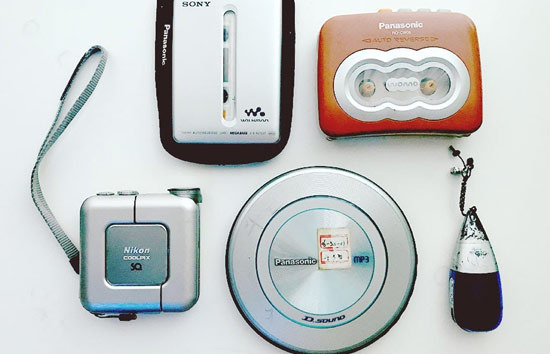
When talking about music from the past, there are always people who say, "It was better back then," but when it comes to actual sound quality, the advancements are definitely noticeable.
Cassette tapes, CDs, and DVDs may sound almost similar when listened to casually, but the technology has clearly progressed in stages.
First, let's talk about cassette tapes, especially metal tapes. It's often said that "metal is the best."
Compared to normal (Type I) or chrome (Type II), metal (Type IV) definitely has higher resolution, clearer highs, and less noise.
At the time, it was almost the pinnacle of technology. However, it is only the best "among cassettes."
The structure itself is analog tape, so hiss noise (the hissing sound) is inherently present.
No matter how good the deck is, it cannot be completely eliminated.
The dynamic range is also limited. In simple terms, there are areas where the sound gets muddled.
Next is the CD. This is where the game changes. A Compact Disc is not analog but digital. The basic specs are 44.1kHz, 16bit. This is important because it covers almost the entire range of human hearing while virtually eliminating noise.
The background noise that was audible on cassettes disappears, and the sound becomes much clearer. The dynamic range also widens significantly.
It expresses the difference between soft and loud sounds more accurately. That's why when CDs first came out, people felt, "Wow, this is clean." It really did become cleaner.
Then, moving to the DVD category, it goes up another level. DVDs were originally for video, but there were formats like DVD Audio for audio. Here, the specs can go up to 48kHz, 96kHz, and even 192kHz.
The bit depth can also reach 24bit. This means there is much more information than on a CD. Theoretically, it allows for more delicate and broader expression. Especially in classical or live recordings, the sense of space becomes more pronounced.
So, to summarize the order: cassette metal → CD → DVD audio. Technologically, it's clear that the new technology is better.
But the question that arises is, "Can people really feel the difference when they listen?"
When moving from cassette to CD, everyone can feel it. The noise disappears, so the difference is immediately noticeable.
However, the story changes when going from CD to DVD audio. The equipment needs to be good for it to matter.
Metal tapes were the "best effort of analog," CDs are "completed digital," and DVD audio is closer to "excessive specs."
While technology has continued to advance, there are aspects where human ears and listening environments have not kept up.
Ultimately, when emotions are included, the story changes again. Some people love the warm feeling unique to cassettes, while others prefer the cleanliness of CDs. But purely in terms of sound quality, the answer is simple. Analog tapes lost long ago, and digital has taken over.
As a side note, cassette tapes are not completely gone even now. Some companies in the U.S. and Europe still produce them, and in Japan, they continue to sell due to retro demand.
However, they are no longer the central technology in the music market as they once were, and they have transitioned to a hobby and emotional aspect, surviving as a form of nostalgia.
 IowaFirstSnow







 California Dreamer |
 Sugar Cream Door Bulletproof Noodles |
 Investment Campus Home Ownership |
 U.S. Retirement Pension Information |

 Victory 1988 |
 There Are Such Things in the World |

 Anjollinya Blog |
  Min's blog |
  Tora Tora |
  pixel77 |
  cuteasducks |
  Lemon Kim |
  What can make money? |
  An ant castle |
  Haha and Bomi Blog |
  glenview 89 |
  Valley Hong |
  novapixel |
  Idaho's Sumi's House |
  Mr. Midwest America |
  wildfire |
  legalway |
  postcard |
  cheesecake07 |
  My Miami Stories |
  windylotus |
  Mia Flori |