

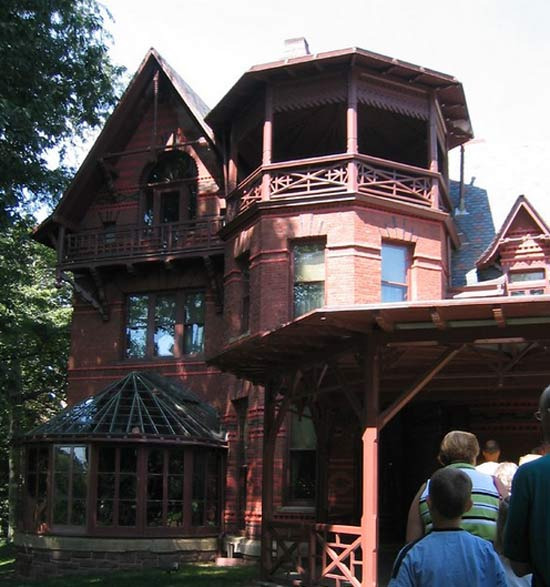
Thinking that I wanted to slip into history for a day with a like-minded friend, I decided to visit the Mark Twain House located near Hartford. The navigation said it would take just over 20 minutes, but I drove slowly, enjoying the autumn scenery filtering through the trees along the road.
As I parked the car and walked towards the entrance, I felt a subtle thrill the moment I saw the building. The Victorian mansion, with its blend of brown and red brick tones, had the atmosphere of a place where a literary figure from that era might have stayed, making it feel like I had stepped into a scene from a novel.
When I think of Mark Twain, the first works that come to mind are 'The Adventures of Tom Sawyer' and 'The Adventures of Huckleberry Finn.' Following the pranks and adventures of young boys, one realizes that these are not just simple coming-of-age stories, but works that deeply reflect the racial issues, class, and longing for freedom in the Southern United States at that time.
The story of Huck Finn and the runaway slave Jim traveling down the Mississippi River naturally incorporates questions about human nature and the struggles for freedom, and it is significant that it directly addressed the taboo issues of race and society at that time.
There are also works like 'The Prince and the Pauper,' which satirizes the switching of identities, and 'A Connecticut Yankee in King Arthur's Court,' which features sharp humor as a modern person falls into the medieval era. Looking at it this way, Twain seems to be a remarkably talented writer who could make his writing easy to read while hitting the core of the matter.
I signed up for an internal tour and opened the door with the guide, and my first impression was, 'It's warmer than I expected.' I even muttered to myself, 'Ah, Tom Sawyer and Huckleberry Finn must have been born here.'
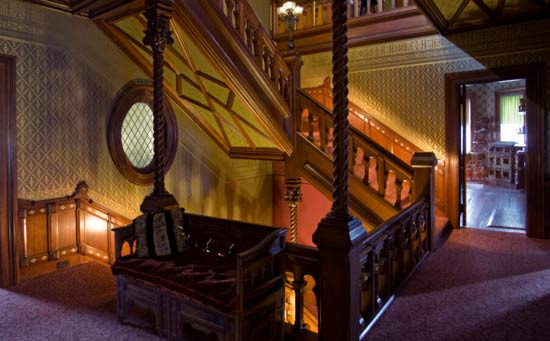
The smell of old wood, the creaking of the stairs, the soft light coming through the windows, and the clock above the wall fireplace subtly seemed to tell the time. Each room had books, and the writing desk was very simple but had a strong presence.
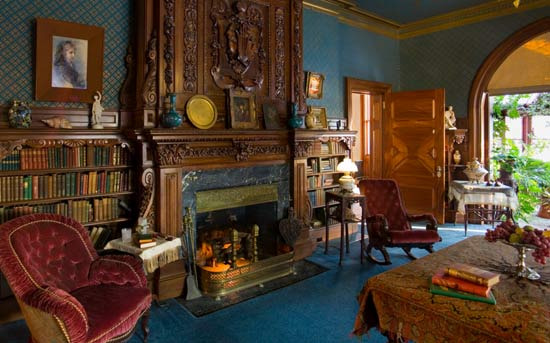
The guide told us that Mark Twain spent the golden years of his life in this house, and indeed, traces of laughter and tears with his family were left everywhere. Especially the study where he immersed himself in writing felt like a space where I could sense the breath of a literary figure, making it hard for me to leave for a while.
On the desk was a model of a pen that he used at the time, and on the opposite wall were shelves filled with books, an old world map, and a worn-out chair, which made me want to gently touch the backrest with my fingertips. Since I also enjoy writing, I felt strangely connected to the thought that 'this person sat here recording stories of the world.'
Following the guide, I toured the bedroom, dining room, and the space where the family gathered to listen to music, and the piano room, where the daughters often played, was particularly bright with sunlight streaming in. Standing by one of the windows and looking down at the garden outside, I saw children playing on the lawn in the distance, and for a moment, it felt like I was time traveling. Surely, laughter must have filled the house through the window frames back then.
Finally, I slowly walked through the garden behind the house, breathing in the air, and it was a place that felt quiet yet rich in energy. I felt a sense of calm, and suddenly thought, 'I understand that literature is born in such spaces.' After finishing the tour, I bought a few postcards at the gift shop and on my way home, I stopped by a café to enjoy a warm latte while reflecting on the day's impressions.
Experiencing the life of a writer in a real space felt like discovering warmth from a figure I had only encountered through books, and I was secretly pleased that the scenes I saw that day remained vividly in my mind. Sometimes, a very short visit that we might not call a trip leaves a deeper impression. My visit to the Mark Twain House was just that.
It was a place I had postponed visiting even though I lived nearby, and now that I have been, I wonder why I waited so long, feeling grateful once again that there is such a cultural gem in Connecticut.
If I were to compare Mark Twain to a Korean writer, I often think of Jo Jung-rae. Both are widely known to the public and share the commonality of sharply capturing social perspectives through their novels. While Jo Jung-rae's 'Taebaek Mountain Range' or 'Arirang' deals with the conflicts and lives of the people in modern Korean history, Twain's works humorously and satirically unravel the history and racial issues of the American South.
Behind the playful adventures of Tom Sawyer and Huckleberry Finn lie profound questions like 'What is freedom?' and 'How is moral judgment formed?' Jo Jung-rae also deeply weaves social wounds and history into his narratives. Thus, the two writers are similar in that they are storytellers who recorded their times. They are enjoyable to read, but once finished, they leave a lingering thought or a twinge in the heart.
Someday, when my child grows older and starts reading, I want to come back again. At that time, I want to hold my child's hand and slowly walk through the rooms, sharing the excitement I felt.







 candytip |
 Gold Bar |
 Pirate Ship Popcorn Maker |
 Montgomery Mom |
 Anjollinya Blog |
 Jin Soo V |
 Buckwheat Muktudari Notebook |


 Tonky |
  viroma |
  cookie |
  Live and that's it |
  Alright Twain |
  eatontown blog |
  HAWAII Korean Church News |
  Amore |
  linex |
  Balancework |
  laro90 |
  MEDBIO American Doctor Blog |
  SWAT TEAM BLK |
  DREAM BIG |
  frostbite |
  330 Forever My Love |
  El Dorado |
  dralix58 |
  Gorama Round |
  Skydiving |