

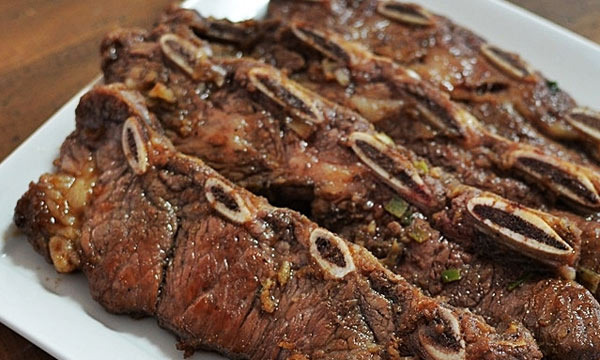
The leading hypothesis about when and how LA Galbi started is that it was initiated by the first-generation Korean immigrants in Los Angeles in the 1960s.
At that time, Korean immigrants who moved to the United States could somewhat manage rice and soup. They could cook rice because of the Calrose rice grown in California, and they could prepare simple soup ingredients.
The problem was beef. In Korea, there has been a culture of marinating beef in seasoning and slicing it thinly to eat as a side dish, but the typical meat culture in the U.S. was entirely different. It involved grilling thick chunks of raw meat like steak, which was unfamiliar and not very appealing to Koreans.
Korean-style galbi needs to be cut and marinated before grilling, but trying to do this process the same way in the U.S. posed a problem. The cost of labor in the U.S. was high, and cutting galbi with a knife would significantly increase the expenses. It became too burdensome for immigrants with light wallets to afford.
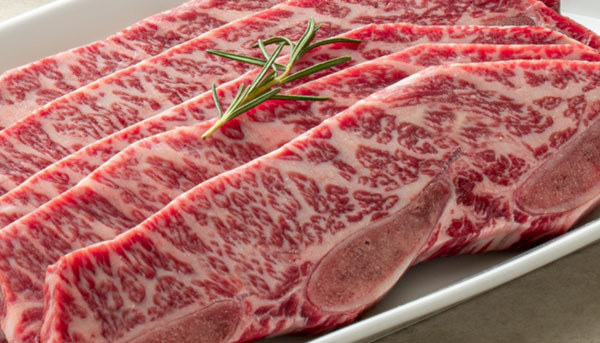
During this time, a new method emerged. Instead of using a knife, they used a cutter to cut the ribs at right angles, known as the Flanken Style Cut. The galbi cut this way had a unique shape with small bone pieces attached to the meat, and it was inexpensive and easy to cook.
Since it was cut thinly, it was perfect for marinating in Korean seasoning and grilling, and it was easy to eat right after cooking. Thus, the first-generation Koreans adapted this Flanken Style galbi to create the unique dish known as LA Galbi.
The charm of LA Galbi is that it does not require a complicated preparation process; just marinate and grill it, and it's done.
It quickly spread because it could be easily prepared for holidays, family gatherings on weekends, church events, and neighborhood barbecue parties. Originally, galbi jjim was a more representative dish during Chuseok or Seollal, but since the 2000s, LA Galbi has become much more popular and is now an essential menu item on holiday tables.
Moreover, the taste varies significantly depending on the cut. The most delicious part is the LA Galbi cut from the 6-8 number flanken ribs, which is rich in marbling and full of juice. You can identify it by the bone shape; if you see about three large bone pieces shaped like a blade, it is definitely the flanken rib part.
Ultimately, LA Galbi can be seen as a typical immigrant fusion food born from the meeting of American cutting methods and Korean seasoning culture.
It is also a product reflecting the tastes and lifestyles of Koreans, as well as the economic realities of the time. Today, it has established itself as a representative dish enjoyed not only in Korean markets in the U.S. but also widely in Korea. Interestingly, it has also become known as Korean food to Americans.
Now, LA Galbi is not just a dish but a part of the history of Korean American immigration. It is a result of the wisdom of early American immigrants, still loved by many at family gatherings and barbecue parties today.







 Weekend Movie Blog |
 Beauty, Health, Lifestyle Blog |
 coloradoman |
 Superman Cat Blog |
 Sunny's Travel in America |
  road98 |
  Churros Train Conductor |
  gleeful |
  Burbank Lee |
  Olivia's Blog |
  Bushing Around Life |
  Active |
  Cherokee Rose |
  Kor. Master |
  Holey Moley |
  Conflite Teacher |
  Hodong Prince Over Flex |
  Mist inn |
  citrus pop |
  Onion Ring |
  phoenixia |
  viewtop |
  loverun |
  Kim Do Sun |
  SEVEN SEVEN |