
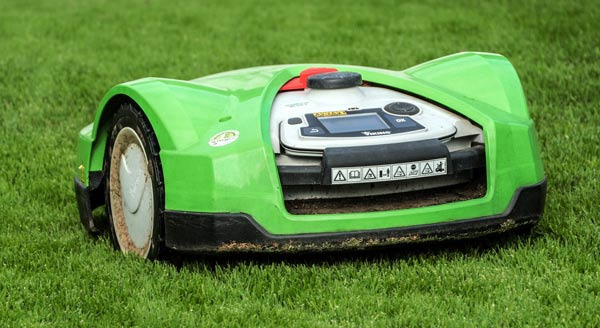
These days, robots do the dishes, clean the floors, and now they even mow the lawn... It feels like the future has stepped right into my front yard.
Robot lawn mowers. It seems like with just a push of a button, you can keep your garden tidy without breaking a sweat, right?
But the reality is a bit different. Robot lawn mowers require more effort than expected and, crucially, can also cause stress.
To have the robot mow beautifully through the garden, you first need to inform it of the boundaries.Most models require a boundary wire to be buried or fixed around the garden's edge to operate.
Without that wire, it doesn't know where to mow, so it just spins around aimlessly or goes off in the wrong direction.
However, installing this wire is surprisingly cumbersome. You have to dig the ground with a shovel and hide the wire nicely.
And what if you later want to move a flower bed? Yes, you have to start all over again. The wire needs to be laid down again.
Humans can avoid dog poop, stones, and branches while mowing. But the robot? It just crashes into them.
High-end models may stop briefly, but most just pause and wonder, "What is this?" or get stuck in place.
Especially in homes with children, where toys or random items are often left in the garden, there's a 99.9% chance the robot is sending SOS signals every day.
Most robot lawn mowers are prohibited from operating on rainy days.
There are smart models with sensors that detect rain and stop automatically, but budget models lack such features and will just merrily roam around in the rain until they break down.
Moreover, if the grass is wet, clippings stick to the blades, making it dirty and not mowing cleanly.
The robot does go back to charge on its own, but in a large yard, it can get stuck in an infinite loop of low battery → charging → returning → low battery again.
As a result, there are times when you turn it on in the morning, and it doesn't finish its work until dusk.
Additionally, batteries are consumables that need to be replaced every 2-3 years, and they can be quite expensive.
Robots with decent performance start at over $1,000, and once you add GPS features and smart app integration, it easily exceeds $2,000.A robot quietly moving around at night, cute, you say? For hedgehogs or baby rabbits, it's a terrifying 'murder vacuum cleaner.'
In fact, in Europe, there have been calls to regulate robot lawn mowers due to wildlife damage.
And while they claim to operate quietly without noise concerns, once you use one, the sounds of the brushless motor, blades whirring, and the machine bumping into things can be quite loud.
The reality is that you have to set boundaries, clear obstacles, check the weather, monitor the battery, and regularly maintain the machine. At this point... it might just be easier to mow by hand.To sum up, "Just install it and you're done!" is absolutely not the case.
A high-maintenance machine. If you don't have a passion for it or aren't a tech enthusiast? You might as well pass it by.
Even the truly lazy find managing a robot to be a hassle.








 U.S. Supreme Court Judge Kim |
 Egg Steamed Pot |
 Learn English Accurately |
 Magic Cabbage School of Martial Arts |
 Peach Jam Eating Laughter |
  US Embassy |
  Korean Mom |
  My NYC |
  moo moo |
  Mr Oh |
  forevergee |
  festival |
  manchester |
  constant |
  Leapfrog Move |
  vibranto |
  Tora Tora |
  yellowbutter |
  Dolly |
  NYC saladbar |
  Finding Superfoods |
  lightyear |
  song bang |
  vexomo |
  Indiana Jones |