

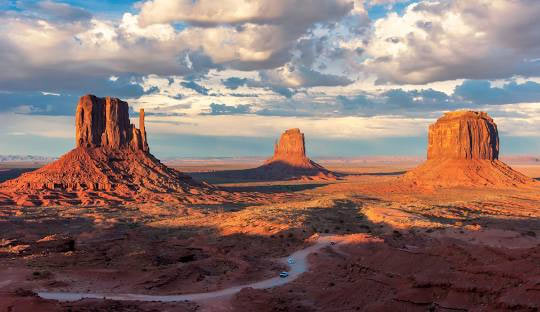
This place is famous for its unique terrain and dry desert climate, which attracts countless travelers every year to experience its 'exotic nature.' The symbol of Tucson is undoubtedly the saguaro cactus.
This giant cactus, which can grow up to 12 meters tall, can be encountered directly at the Saguaro National Park. The park is divided into two areas, east and west of Tucson, and the orange sunset falling between the cacti at dusk is truly like a scene from a movie.
Unlike the flat terrain of the desert, the western side is home to the Tucson Mountains. Among them, 'Gates Pass' is famous as a spot where locals go to watch the sunset. As you drive up the winding road that can barely fit one car, a spectacular view of red rocks and the shadows of the desert unfolds.
Heading north of Tucson, the atmosphere changes dramatically.
This is due to the 'Catalina Mountains.' This area, which rises over 2,700 meters above sea level, is popular as a summer retreat and a ski resort in winter. The view of the snow-covered mountains and the dry desert below is truly fascinating.
Going south, you will find the 'Santa Rita Mountains,' where grasslands and forests coexist, making it a great place to escape the desert when you long for greenery. Madera Canyon is a hiking trail famous for its bird songs and cool air, and it is a healing spot for locals.
Looking at the terrain of Tucson, you might wonder, 'How was all this formed?' In fact, most of these mountains are the result of volcanic activity and tectonic shifts millions of years ago. Therefore, the rocks are diverse. They consist of volcanic rock, sandstone, and limestone, shaped into unique forms over long periods of erosion. Additionally, minerals like copper and molybdenum were abundant, making mining a key part of the local economy in the past.
Many former mining sites have now become tourist attractions. What stands out in the middle of the desert is the 'pavement terrain.' With almost no rain and strong winds, the soil has blown away, leaving stones that cover the ground like tiles.
The climate in Tucson is aptly named 'hot desert climate.' Summers are truly hot and dry. However, from late June to September, the monsoon arrives. Suddenly, lightning, thunder, and heavy rain pour down, briefly revitalizing the desert. The average annual rainfall is about 280mm, which is low, but it rains intensively during this short period. In winter, there is almost no snow, but you can see white snow at the top of the Catalina Mountains.
Thus, Tucson is not just a simple desert city, but a natural textbook where geology, ecosystems, and human life intertwine. Under the hot sun during the day and the starry sky at night, one can feel both the vastness and tranquility of nature. That's why many travelers say, 'Tucson is not just a desert, but a living landscape itself.'




 candytip |
 Gold Bar |
 Pirate Ship Popcorn Maker |
 Montgomery Mom |
 Anjollinya Blog |
 Who's watching? |
 AZ Road Master |


 TOTO Together |
  Tonky |
  viroma |
  cookie |
  Live and that's it |
  Alright Twain |
  eatontown blog |
  HAWAII Korean Church News |
  Amore |
  linex |
  Balancework |
  laro90 |
  MEDBIO American Doctor Blog |
  SWAT TEAM BLK |
  DREAM BIG |
  frostbite |
  330 Forever My Love |
  El Dorado |
  dralix58 |
  Gorama Round |
  Skydiving |