

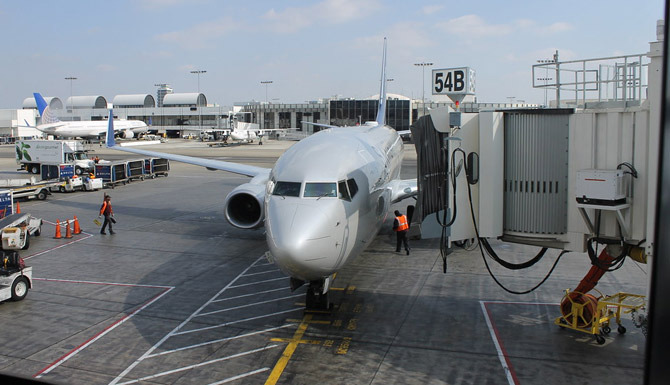
The price of airline tickets we pay when flying does not simply include the operating costs of the airline.
There are various usage fees and service charges imposed by airports on airlines that are hidden.
There are over 5,000 airports in the United States, and among them, about 500 airports with active commercial flights require airlines to pay 'Airport Fees' daily.
Interestingly, even for the same route, the amount airlines have to pay can vary significantly depending on the airport.
First, the main costs that airlines pay to airports can be broadly divided into three categories. The first is the Landing Fee. This is the cost incurred when an aircraft uses the airport runway, and it varies based on the Maximum Takeoff Weight (MTOW) of the aircraft. For example, Delta Airlines' Boeing 737 and Korean Air's large Boeing 777 have different weights, resulting in landing fees that can differ by thousands of dollars. The second is the Gate Fee.
This is the fee for occupying a passenger boarding gate for a certain period. This fee is higher at airports with lower turnover rates, meaning larger hub airports with limited gate numbers. The third is the Terminal Lease or Parking Fee, which is charged when an aircraft stays at the airport for a certain period.
In addition, there are additional costs such as Navigation and Air Traffic Control Fees, Fuel Flowage Fees, and Security Fees. Atlanta's Hartsfield-Jackson International Airport (ATL), one of the major airports in the U.S., serves over 100 million passengers annually, but due to economies of scale, it charges relatively low landing fees to airlines. In contrast, New York's JFK and Los Angeles' LAX have very high land costs and infrastructure maintenance fees, resulting in thousands of dollars more in fees for the same aircraft landing.
So why do these differences occur between airports? The key reason lies in the operational methods and financial structures of the airports. Most airports in the U.S. are 'public facilities' owned by local governments or city authorities, but each airport operates with an independent financial structure. The Federal Aviation Administration (FAA) provides basic rules, but actual fee setting is at the discretion of the airport operators.
For example, Denver International Airport (DEN) covered its construction costs with bonds issued by the airport itself, so it had to recoup those costs through airline fees. Conversely, Dallas Fort Worth Airport (DFW) expanded through joint investment with airlines, resulting in relatively lower fee burdens.
Passenger numbers and route diversity are also important variables. Airports with many passengers can set lower fees for airlines due to broader revenue sources, but smaller regional airports with fewer passengers must charge higher landing fees to remain operational. In fact, medium-sized airports in Montana or Alaska operate primarily with small commuter flights instead of major airlines and can charge fees exceeding $1,000 per landing.
Interestingly, some U.S. airports offer landing fee waivers or discounts to attract airlines. For example, they may waive landing fees for a certain period for newly launched routes or provide incentives to airlines with frequent flights. Thanks to such policies, certain regional airports can secure new routes and stimulate the local economy.
Another pillar of airport revenue is Non-Aeronautical Revenue. This is income generated from passengers and shops rather than airlines, including parking fees, duty-free shop rents, advertising, and rental car commissions. At some airports, this non-aeronautical revenue can exceed 50%, allowing those airports to lower airline fees. For instance, Las Vegas McCarran Airport (LAS) can maintain low landing fees for airlines due to slot machine revenues and duty-free shop rents.
Ultimately, the differences in fees between airports reflect the economic power, operational structure, traffic demand, and policy direction of the region. For airlines, these costs are included in ticket prices, which is why a flight to New York can be more expensive than one to Dallas, even for the same distance.







 candytip |
 Gold Bar |
 Pirate Ship Popcorn Maker |
 Montgomery Mom |
 Anjollinya Blog |
 squidogame |
 Margarine Daebimama |
 eatontown blog |
 cloudyday |
 Google Idea |
  US Embassy |
  Korean Mom |
  My NYC |
  moo moo |
  Mr Oh |
  forevergee |
  festival |
  manchester |
  constant |
  Leapfrog Move |
  vibranto |
  Tora Tora |
  yellowbutter |
  Dolly |
  NYC saladbar |
  Finding Superfoods |
  lightyear |
  song bang |
  vexomo |
  Indiana Jones |