
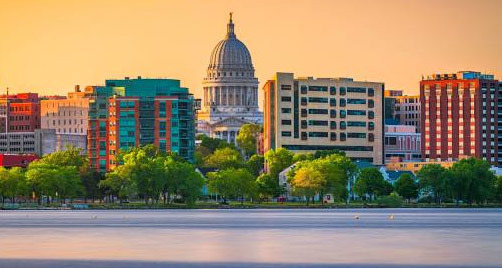
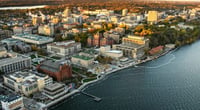
Madison, Wisconsin has developed as a center for politics, education, and culture, being the state capital and the second largest city in the state. The history of Madison encompasses various stories from the Native American era to European settlement and the development into a modern city.
Land of the Natives
- The Madison area has been inhabited for thousands of years by various Native Americans, including the Ho-Chunk tribe.
- They lived through hunting, agriculture, and fishing, particularly gaining abundant resources from nearby lakes such as Mendota and Monona.
- In the vicinity of Madison, archaeological sites of mounds have been discovered, providing important insights into their culture.
European Settlement and City Formation
- In 1836, Madison was chosen during the process of selecting the capital of the Wisconsin Territory.
- The city was named after former President James Madison, who was famous as a drafter of the U.S. Constitution.
- From its inception, Madison was planned to be a political center. James Duane Doty purchased the area and promoted the construction of the capital.
- Madison officially began its role as the capital with the construction of the state capitol building in 1837.
Development as a State Capital
- In 1848, as Wisconsin became the 30th state of the United States, Madison was officially designated as the state capital.
- The city was designed to be located in a valley between four major lakes (Mendota, Monona, Waubesa, and Kegonsa), maximizing the use of the natural environment.
- The early economy relied on agriculture and lumber, but later diversified with railroad connections and the establishment of educational institutions.
Establishment of the University of Wisconsin-Madison
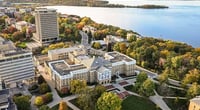
- In 1848, the University of Wisconsin-Madison was established.
- This university played a crucial role in developing Madison as a center for education and research.
- Today, the University of Wisconsin-Madison is regarded as one of the top public research universities in the United States, significantly impacting the city's economy and culture.
Industrialization and Urban Growth
- In the late 19th century, Madison developed into a center of commerce and transportation due to railroad connections.
- While agriculture and manufacturing were the main economic activities, government and educational institutions later became the core of the city's economy.
Modern Madison
- 20th Century:
- Madison became known as a center for progressive politics and civic movements.
- In particular, during the 1960s and 1970s, it was active as a hub for the anti-war movement and the civil rights movement.
- Today:
- Madison stands out not only in politics and education but also in the technology industry and medical research.
- It is particularly growing in the fields of biotechnology, software development, and renewable energy, with many startups establishing their headquarters in Madison.
The Present of Madison
- Population: Approximately 270,000 (about 690,000 including the metropolitan area), making it the second largest city in Wisconsin after Milwaukee.
- Main Economic Activities:
- Research activities related to the University of Wisconsin-Madison and high-tech industries.
- Public sector jobs related to the state government.
- Culture and Quality of Life:
- Madison has been repeatedly selected as "the best city to live in America."
- It features lakes and natural scenery that run through the city center, vibrant arts and music activities, and excellent school districts.
Madison occupies a unique position in the Midwest as the capital of Wisconsin and a center for education, politics, and culture. From its Native American heritage to its development into a modern city, Madison is a city where history, nature, and a progressive spirit harmoniously coexist.




 moo moo |
 ultron78 |
 garlic bread |
 Sugar Cream Door Bulletproof Noodles |
 urbanmint |
 middlekick |
 Superman Cat Blog |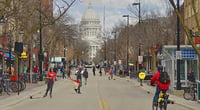
 Forever Coco is Bangga |
 Tonky |
  viroma |
  cookie |
  Live and that's it |
  Alright Twain |
  eatontown blog |
  HAWAII Korean Church News |
  Amore |
  linex |
  Balancework |
  laro90 |
  MEDBIO American Doctor Blog |
  SWAT TEAM BLK |
  DREAM BIG |
  frostbite |
  330 Forever My Love |
  El Dorado |
  dralix58 |
  Gorama Round |
  Skydiving |