
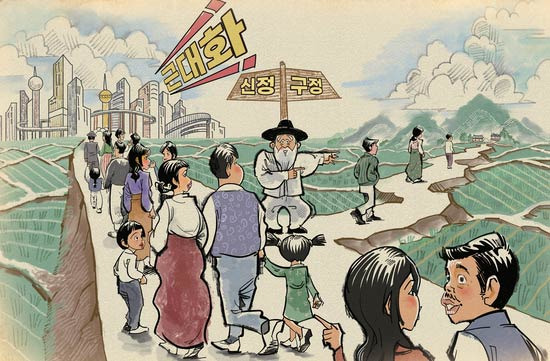
When living in America, I often hear about Korea through the news first.
I saw an article about the discussion of abolishing Seollal in Korea, and it seems that some people are taking it quite seriously.
Honestly, my thought is this: Korea celebrates the New Year twice.
Once on January 1st, and then again during the lunar New Year. After living in America for a long time, it sometimes feels a bit strange.
"Do we really need to do it twice?" This thought naturally comes to mind.
Factually, Seollal is still the biggest holiday in Korea.
The official name isn't 'Lunar New Year' but simply Seollal, and it usually comes with a three-day holiday.
During the holiday period, tens of millions travel, KTX trains are packed, and highways turn into parking lots.
Companies halt operations, logistics are delayed, and small businesses see a drop in sales.
That's why some people say, "Let's only celebrate the solar New Year and get rid of the lunar one."
This sentiment is sometimes seen among office workers and the younger MZ generation.
However, realistically, there's no serious discussion about abolishing Seollal. It's still just opinions circulating online.
Seollal isn't just a holiday; it's a family event. Rituals, bowing to elders, family gatherings. It's not easy for all of that to disappear at once.
But living in America, the meaning of Seollal completely changes. Among Koreans here, the atmosphere is like this.
"What's the exchange rate?"
"Did you send your parents their allowance?"
"How much should I send my nephew for Seollal?"
It feels less like a holiday and more like a remittance season.
Even if I can't eat tteokguk, I still wire money. Sending greetings via KakaoTalk and having a video call wraps up the holiday event.
Maybe that's why I personally feel this way. When I was in Korea, Seollal felt like a traffic nightmare, a holiday stress, and the feeling of celebrating the New Year twice. But after coming to America, the emotional aspects have diminished, leaving only the financial events.
So, it's not strange to think, "Wouldn't it be cleaner to just celebrate once on the solar New Year?"
But what if Seollal were to disappear? It would probably feel strange.
What was once a bothersome holiday in Korea might suddenly be something I miss in America.
In the end, the discussion about abolishing Seollal seems to mix issues of efficiency and emotion.
However, from the perspective of living abroad, whether we celebrate Seollal twice or once, what comes to us first is the exchange rate alert, not the calendar.
As the holiday approaches, my routine is always the same. I send greetings on KakaoTalk, wire money, and then I think to myself.
"There's no Seollal atmosphere... but money flows like during the holidays."






 fortbliss |
 Folding Instructions |
 yentra |
 Cali M Law Group |
 quanta7 |
 Pirate Ship Popcorn Maker |
 Total Beauty |
 California Information News |
 ROLDU WAY |
 OC Real Estate Business Information |
  Korean Mom |
  My NYC |
  moo moo |
  Mr Oh |
  forevergee |
  festival |
  manchester |
  constant |
  Leapfrog Move |
  vibranto |
  Tora Tora |
  yellowbutter |
  Dolly |
  US Embassy |
  NYC saladbar |
  Finding Superfoods |
  lightyear |
  song bang |
  vexomo |
  Indiana Jones |