

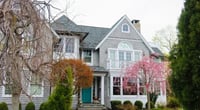
Cresskill has been a town that has consistently been discussed for its school district and living environment in Bergen County over the past 20 years. From my long-term observation of the local market, Cresskill's population has remained stable at around 9,000, but there has been a noticeable increase in inquiries from households moving in from New York over the past 3 to 4 years.
The area itself is more residential than industrial, but the commercial districts in nearby Teaneck and Englewood Cliffs, along with access to Manhattan via the George Washington Bridge, effectively support the local job market. In recent years, as remote and hybrid work have become established in the healthcare and financial services sectors, professional households that no longer need to commute daily to Manhattan have started to take a renewed interest in suburban towns like Cresskill.
The unemployment rate in Bergen County remains in the mid-3% range, lower than the New Jersey state average, and household income growth has been steadily around 3-4% annually. Based on over 20 years of market observation, this area has shown a tendency for gradual cycles rather than sharp fluctuations.
In terms of infrastructure, discussions about improving the small commercial district in downtown Cresskill and expanding nearby roads are ongoing, while improving access to buses and ferries to New York is a long-term goal for Bergen County as a whole. Large-scale data centers or logistics facilities are more concentrated in central New Jersey than in Cresskill itself, suggesting that the growth of this area is likely to be driven more by residential demand than by industrial attraction.
According to migration statistics from the Milken Institute and U-Haul, northern New Jersey suburban areas are not considered explosive growth regions, but they are also not experiencing significant outflows. This means that Cresskill is likely to show a trend of stable maintenance rather than dramatic growth.
However, risks certainly exist. The property tax burden in New Jersey is a recurring topic each year, and during periods of high interest rates, transaction volumes have noticeably decreased. Given the market's dependence on school districts, changes in student numbers or demand for private school alternatives are variables that need to be monitored.
For Korean households, it seems reasonable to approach Cresskill as a long-term residential asset considering both children's education and retirement, rather than a short-term investment. The sales prices have shown a gradual upward trend, while rents have demonstrated stable demand in the area.
In summary, while Cresskill may not boast a flashy growth story, it can be evaluated as a region likely to maintain significant stability over the next 10 years, based on its long-validated stability and educational infrastructure.
 OldLocustRmn
 MeadowMedia





 garlic bread |

 urbanmint |
 |
| 
 Premium Gas Camp |
 Living in New Jersey blog |
 Lemon Kim |
 forestcloud |
 forestbon |
 andrew park |
  ollege Mom |
  Esther 1983 |
  Arizona AZ Cowboy |
  fortbliss |
  Moscow Kim |
  My Two Way |
  toastyfox |
  FLORIDA Acus |
  tracker |
  TONTON COFFEE |
  sunrise |
  ultron78 |
  uplifted |
  Folding Instructions |
  same same life |
  USA Hyundai Kia |
  morvex37 |
  BOL SA RAM |
  TOUCHE NEWS |
  Small Business Information USA |