

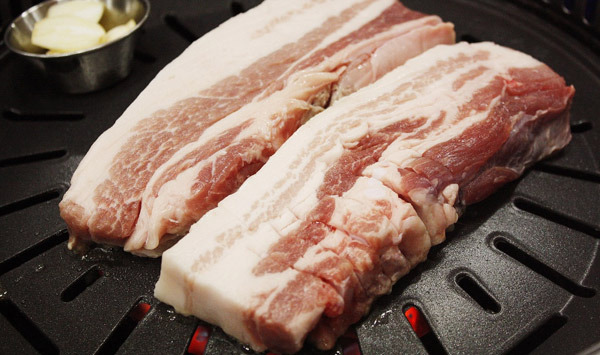
If you have ever said or heard the phrase, 'Let's clean our throats and grease our bellies after work' in the 90s, you are a Korean who has lived through a dynamic era. Haha.
Even now, pork belly is the star of conversations that rise from the grill, soothing the fatigue of the day, often accompanied by a glass of soju.
Koreans especially seem to enjoy the feeling that all the worries of the world disappear with a bottle of soju and well-cooked pork belly.
But how do Americans view this pork belly culture?
First of all, many are surprised to see such fatty pork belly being eaten according to American standards.
They often react with, "Why are they grilling such fatty meat?"
Moreover, American barbecue is centered around grilling/oven cooking, so the Korean method of grilling on a hot plate feels somewhat unfamiliar.
However, Americans who have experienced it once find the sound of the meat cooking, the aroma that wafts when the kimchi is grilled alongside, and the way it is eaten wrapped in lettuce all fascinating. One American said, "This feels like more than just eating meat; it feels like an event."
The table, lavishly set with side dishes, rice, meat, and vegetables, the skillful hands of the person grilling, and the atmosphere of laughter and conversation combine to feel like a performance. Thus, it seems that the pork belly culture is rapidly spreading in the U.S. under the name 'Korean BBQ'.
When you look for Korean barbecue videos on YouTube or TikTok, foreigners often say, "This is an experience you must try at least once."
In Korea, there is an unwritten rule about not flipping the meat too often, but Americans are unaware of such rules. They flip the meat freely or try to adjust the heat, sometimes burning the meat. Also, in Korea, one person grills while others wait and chat, but Americans ask, "Why is one person grilling while the rest just watch?"
However, these differences create fun. An American friend grilling the meat gets surprised and laughs when the oil splatters, while a Korean friend pours soju and cheers, "Cheers!"—this is where the two cultures naturally blend on the grill.
Another interesting point is the relationship between 'pork belly and alcohol'. In the U.S., the culture of drinking alcohol during meals is weak, but Korean-style pork belly gatherings usually include soju and beer. Before long, Americans also happily mimic the cheers, "Cheers!"
This combination seems to feel very fresh to Americans. They say, "This is not just a meal; it feels like a social experience." In reality, pork belly is not just food to fill the stomach but food to fill relationships.
Just as Japanese cuisine has established itself in the U.S. alongside Japanese products, it seems that pork belly is gradually becoming a 'trendy food' along with the Korean Wave.
Especially in cities like LA, New York, and Chicago, pork belly restaurants are gaining popularity as hot spots for the younger generation.
It is heartening that Korean barbecue is no longer an exotic food but is being embraced as a lifestyle enjoyed together in America.


 Weekend Movie Blog |
 Beauty, Health, Lifestyle Blog |
 coloradoman |
 Superman Cat Blog |
 novapixel |
  DREAM BIG |
  frostbite |
  330 Forever My Love |
  El Dorado |
  dralix58 |
  Gorama Round |
  Skydiving |
  dreamport |
  Yellow Snowman |
  Toaster Pizza Magic Show |
  velvetnom |
  Anytime Journey |
  Mrs. Duluth |
  jaxter |
  Atlanta Mama |
  Baguette Blog |
  Tan Sol |
  US Embassy |
  Korean Mom |
  My NYC |